Candle Filter vs Bag Filter: Key Differences, Working Principle & Selection Guide
Two of the most widely deployed liquid filtration technologies — yet the logic that separates them is rarely explained clearly. Here is what actually happens inside each one, and how to decide which belongs in your process.
The Same Problem, Two Different Architectures
Candle filters and bag filters solve the same fundamental problem: removing suspended solids from a liquid stream to a defined cleanliness level. Both are pressure-driven. Both operate in batch or semi-continuous mode. Both are found across chemical processing, food and beverage production, pharmaceuticals, oil refining, and water treatment.
Yet specifying one where the other is called for can produce filtration that is too coarse, too slow, too expensive to maintain, or simply incompatible with the downstream process. The decision hinges on three variables that are often glossed over in supplier literature: the nature of the solids being removed, the required filtration precision, and what happens to those solids after they are separated from the liquid.
How a Candle Filter Works
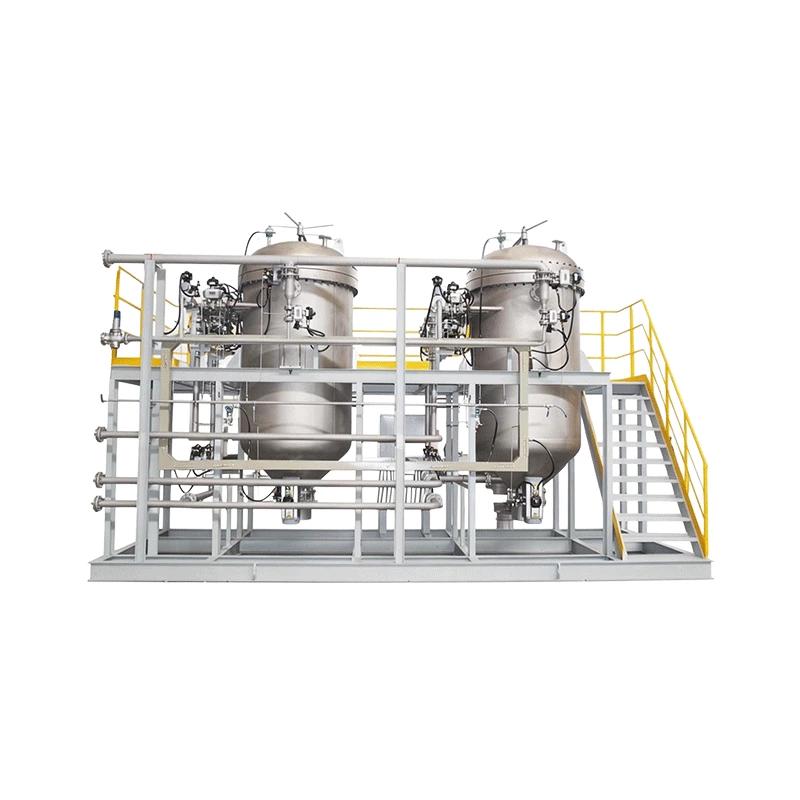
A candle filter houses an array of rigid, tubular filter elements — the "candles" — arranged vertically inside a pressure vessel. Each element is typically 50 to 150 mm in diameter and 500 to 2,000 mm long, manufactured from sintered metal powder, ceramic, porous plastic, or wound wire. The liquid to be filtered enters the vessel shell, flows radially inward through the candle walls, and exits through the hollow core of each element as clean filtrate. Particles too large to pass through the pores are retained on the outer surface, forming a filter cake.
Because the pore structure of a sintered or ceramic candle is precisely manufactured, filtration ratings from 0.1 to 100 microns are achievable with high consistency. The elements are rigid and dimensionally stable under pressure; they do not collapse, bypass, or change shape under flow surges.
Cleaning is performed by a pulse of gas (typically nitrogen or compressed air) blown backward through the elements — a reverse-pulse backflush. This dislodges the filter cake, which falls into a collection sump or is discharged as a slurry. In designs intended for cake recovery, the solids are discharged in a dense, handleable form. High-value by-products — catalyst fines, precious metal precipitates, pharmaceutical intermediates — are recovered cleanly with minimal contamination from wash liquors.
How a Bag Filter Works
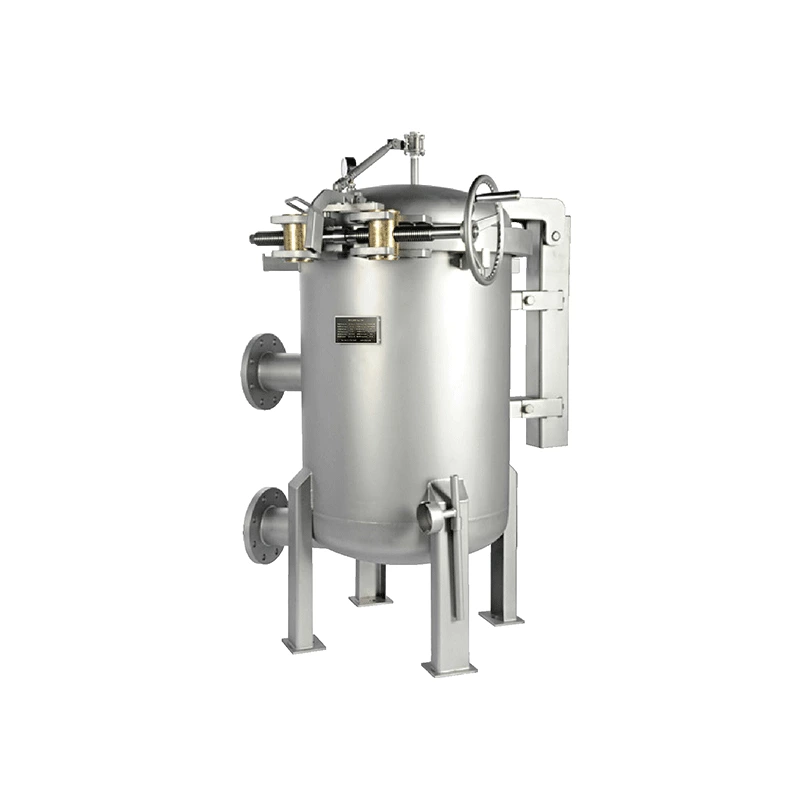
A bag filter replaces the rigid candle elements with flexible fabric bags — typically woven polypropylene, polyester, nylon, or felt — mounted on a support basket inside a cylindrical housing. Liquid enters the inside of the bag and passes outward through the fabric wall; solids accumulate on the inner surface.
Bag filters are manufactured in standard sizes (Size 1: 180 × 810 mm; Size 2: 180 × 430 mm being the most common) and in a wide range of micron ratings, typically from 1 to 1,500 microns. The fabric pore structure is less geometrically precise than a sintered metal candle — actual retention efficiency depends on particle shape, liquid viscosity, and the depth of the solids cake that builds up over time. In practice, a nominally rated 25-micron bag may pass some particles at 30 or 35 microns during the early moments of a clean cycle, before the pre-coat of solids has formed on the fabric.
Bag filters are single-use in most applications. When the bag reaches its solids-loading limit — indicated by rising differential pressure — the housing is opened, the spent bag is removed and discarded, and a fresh bag is installed. This change-out takes minutes and requires no specialised tools, but it generates solid waste and carries a recurring consumable cost. In multiplex installations (multiple housings in parallel), one housing can be isolated for bag change while the others remain online, preserving continuous flow.
Side-by-Side Comparison
| Parameter | Candle Filter | Bag Filter |
|---|---|---|
| Filter Element | Rigid sintered metal, ceramic, or porous plastic tubes | Flexible fabric bag (polypropylene, polyester, nylon, felt) |
| Filtration Precision | High and consistent; 0.1–100 µm, stable under pressure | Moderate; 1–1,500 µm, early-cycle bypass possible on clean bag |
| Element Lifespan | Long; elements cleaned and reused hundreds to thousands of cycles | Single-use; discarded after each loading cycle |
| Cleaning Method | Reverse-pulse gas backflush; no housing opening required | Manual bag replacement; housing must be opened and drained |
| Solids Recovery | Excellent; cake discharged as dense slurry or dry cake, suitable for by-product recovery | Poor; solids are mixed into discarded bag, recovery impractical |
| Solids Loading Capacity | High; thick cake can build up on element surface | Limited by bag volume; high-solids streams require frequent change-outs |
| Operating Pressure | High; rigid vessel and elements tolerate 10–100 bar | Low to moderate; typically 1–10 bar; fabric not suited to high differential |
| Temperature Tolerance | Very high; metal and ceramic elements handle 200–600 °C liquids | Limited by fabric chemistry; most bags rated to 80–150 °C |
| Chemical Compatibility | Broad; stainless steel, Hastelloy, or ceramic elements resist aggressive solvents and acids | Depends on fabric grade; some solvents and strong acids degrade standard bags |
| Footprint | Compact for a given flow rate; many elements per vessel | Larger per unit flow; multiple housings needed at high throughput |
| Capital Cost | High; pressure vessel and precision elements are expensive | Low; simple housing and standard bags are low-cost |
| Operating Cost | Low; no consumable elements, cleaning is automated | Recurring; bag replacement labour and disposal costs accumulate |
| Operator Exposure | Minimal; closed-loop cleaning, no direct contact with solids | Potential exposure during bag change-out; hazmat precautions may be needed |
The candle filter's recurring cost is the capital charge on a vessel that is never opened. The bag filter's recurring cost is the labour and consumables for every bag change. Which arithmetic wins depends entirely on the solids loading rate and the value of what is being filtered.
Selection Guide: Matching Technology to Application
The right choice follows from the process conditions, the nature of the solids, and the operational priorities of the site. Work through the scenarios below as a first screen.
-
Pharmaceutical API and intermediate filtrationStrict precision required, product recovery essential, operator exposure must be minimised, cleaning validation critical
→ Candle -
Coolant and lubricant polishing in metalworkingLow solids loading, intermittent use, low capital budget, easy on-site change-out by operators
→ Bag -
Catalyst recovery in petrochemical and refining processesHigh value solids must be recovered intact, aggressive solvents and elevated temperatures, closed-loop discharge needed
→ Candle -
Paint and coating pre-filtrationCoarse particle removal before application, low precision requirement, fast change-out preferred over capital investment
→ Bag -
Fine chemical and specialty polymer productionHigh differential pressure, elevated temperature, very fine particle cut-point, product purity non-negotiable
→ Candle -
Beverage and brewing final polishingLow microbial risk acceptable at this stage, low solids, disposable elements eliminate cross-batch contamination concerns
→ Bag -
Precious metal liquor filtration (gold, platinum group metals)Every milligram of solids is valuable, losses in disposable elements are unacceptable, dense cake discharge required
→ Candle -
General industrial water treatment (low-duty polishing)Moderate particle load, broad micron range acceptable, operational simplicity preferred over lifecycle optimisation
→ Bag -
Hot melt polymer and resin filtrationVery high temperatures (200–350 °C), high viscosity, aggressive chemistry, continuous operation with minimal downtime
→ Candle
A Framework for Your Decision
Five questions, answered honestly, will resolve most candle-versus-bag decisions before a supplier is ever contacted.
First, what is the value or hazard of the retained solids? If the solids are a recoverable product — a pharmaceutical intermediate, a catalyst charge, a precious metal precipitate — bag filtration is effectively off the table. Solids mixed into a discarded bag cannot be economically recovered. Candle filtration, with its dense cake discharge, is the only practical choice. Conversely, if the solids are a worthless waste stream and disposal is the objective, the recovery advantage of a candle filter is irrelevant and the simpler bag system is sufficient.
Second, what are the temperature and chemical conditions? Polypropylene bags degrade above roughly 80 °C and are attacked by many ketones, esters, and aromatic solvents. Polyester performs better chemically but is still limited to around 150 °C. If the process fluid is hot, aggressive, or both, sintered metal or ceramic candle elements are often the only technically viable option.
Third, what is the solids concentration in the feed? Bag filters work well at low solids loadings — typically below 50 mg/L for practical change-out intervals. Above that threshold, bag replacement becomes so frequent that the labour cost and operational disruption exceed what a candle filter's higher capital cost would have cost over the same period. Calculate the anticipated bag life in hours, multiply by the change-out cost, and compare to a candle filter's annualised capital charge.
Fourth, how important is operator safety? Every bag change-out involves opening a housing, removing a solids-laden bag, and installing a new one. For toxic, carcinogenic, or highly potent compounds — common in pharmaceutical and fine chemical production — this exposure event requires full personal protective equipment and detailed safe-work procedures. Candle filters, cleaned in-situ by gas backflush without opening the vessel, eliminate this exposure entirely. Closed-loop discharge of the filter cake can be engineered to be fully contained.
Fifth, what is the required filtration precision, and how consistent must it be? A sintered metal candle has a defined, manufactured pore size that does not change with flow rate, pressure, or element age. A fabric bag's effective cut-point varies: it is at its coarsest on a new, unloaded bag and at its finest once a solids pre-coat has formed. For applications where the particle size specification is tight and must be met from the first litre of filtrate, candle filtration provides a level of consistency that fabric bags cannot reliably match.
On Pre-coat and Body-feed Techniques
In applications where the solids are compressible — that is, they tend to form a dense, low-permeability cake that blinds the filter quickly — both candle and bag filters are sometimes operated with a pre-coat of filter aid (diatomaceous earth or perlite) applied to the element surface before filtration begins, followed by a continuous body-feed of filter aid mixed into the incoming liquid. The filter aid particles maintain cake porosity and extend run time dramatically. This technique is more commonly seen on candle filters, where the rigid element provides stable support for a thick pre-coat, but bag filters in coarser applications can also benefit from a filter aid body-feed. If your solids are gelatinous, sticky, or compressible, raise this with your equipment supplier before finalising element selection.
Conclusion
Candle filters and bag filters occupy different positions on the cost-complexity spectrum, and the decision between them is not primarily about filtration — it is about what happens to the solids once they are removed.
Where the retained solids are valuable, hazardous, or need to be discharged in a controlled form; where the process runs at high temperature or pressure; where precision must be consistent from first filtrate to last; and where operating costs over a multi-year installation life outweigh the initial capital — candle filtration is the rational choice. Where the solids are low-value waste, the flow is intermittent, the operating conditions are moderate, and simplicity of operation and low capital cost are the governing criteria, bag filtration delivers exactly what is needed without unnecessary complexity.
In practice, the two technologies frequently coexist within a single facility: candle filters protecting high-value process streams, bag filters handling utility and ancillary duties. A thorough review of the specific feed liquid, solids characterisation data, and operational constraints will always produce a more reliable specification than any rule of thumb.
Contact UNITE's technical team for product selection support and quotation.