Gas-Liquid Separator vs Coalescing Filter: Key Differences, Applications & Selection Guide
Understanding the difference between gas-liquid separators and coalescing filters is essential for designing reliable gas filtration systems.
A gas-liquid separator removes bulk liquids and large droplets through gravity or centrifugal force, while a coalescing filter captures fine liquid aerosols and submicron mist using advanced fiber media.
For critical applications such as natural gas processing, compressors, gas turbines, and instrument air systems, these two technologies are often combined to achieve complete gas purification.
Quick Comparison: Gas-Liquid Separator vs Coalescing Filter
| Item | Gas-Liquid Separator | Coalescing Filter |
|---|---|---|
| Main Function | Remove bulk liquids and large droplets | Remove fine liquid aerosols and oil mist |
| Separation Principle | Gravity / centrifugal force | Fiber coalescence + drainage |
| Typical Droplet Size | >25–100 μm | 0.1–100 μm |
| Submicron Aerosol Removal | ❌ Limited | ✅ Excellent |
| Solid Particle Removal | Limited | ✅ Effective |
| Liquid Handling Capacity | Very High | Low |
| Pressure Drop | Very Low | Low–Medium |
| Consumables | No filter elements | Requires element replacement |
| Best Application | Slug removal, condensate separation | Fine mist and oil aerosol removal |
1. Why Gas Streams Need Different Separation Technologies?
Industrial gas streams such as:
- Natural gas
- Compressed air
- Process gas
- Fuel gas
often contain different types of liquid contamination.
These contaminants can be divided into two categories:
1.1 Bulk Liquids and Large Droplets (>100 μm)
Examples include:
- Pipeline condensate
- Water slugs
- Glycol carryover
- Liquid accumulation from process upsets
Because these droplets have relatively large mass, gravity can easily separate them from the gas stream.
A gas-liquid separator is highly effective for this type of contamination.
1.2 Fine Aerosols and Mist (0.1–100 μm)
Examples include:
- Compressor lubrication oil mist
- Fine water droplets
- Amine carryover
- Hydrocarbon aerosols
These particles are extremely small and follow the gas flow path.
Gravity has little or no effect on these aerosols.
A coalescing filter is required to capture these contaminants.
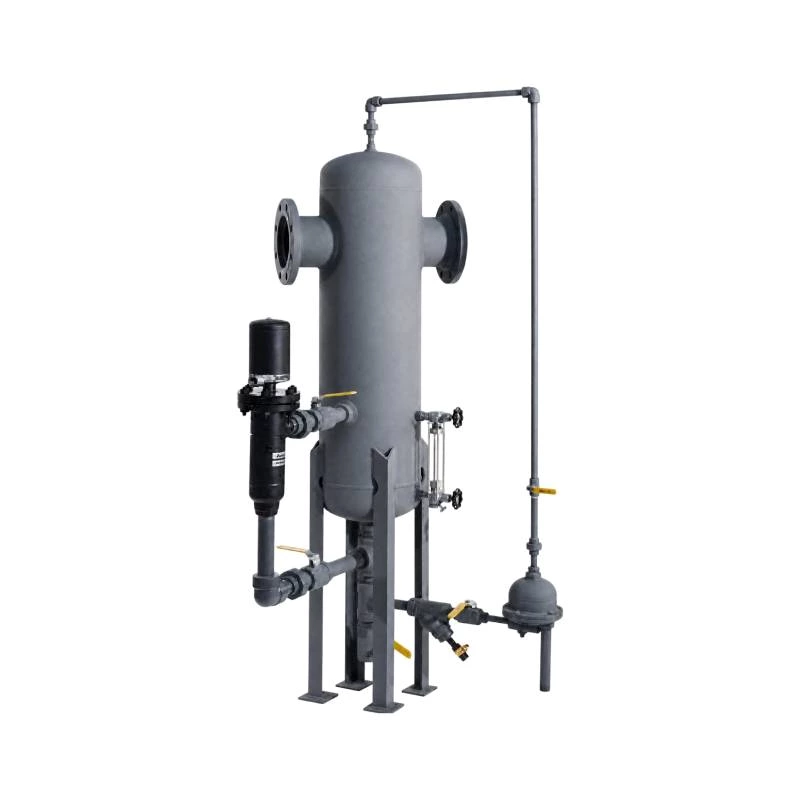
2. What Is a Gas-Liquid Separator?
A gas-liquid separator is a pressure vessel designed to remove free liquids and large droplets from gas streams using:
- Gravity separation
- Centrifugal separation
- Flow direction changes
- Velocity reduction
It is also commonly known as:
- Gas scrubber
- Knock-out drum (K.O. Drum)
- Inlet separator
How Does a Gas-Liquid Separator Work?
The separation process includes:
Step 1 — Gas Inlet
Contaminated gas enters the vessel through:
- Tangential inlet (centrifugal separator)
- Inlet deflector
- Diffuser system
Step 2 — Velocity Reduction & Droplet Separation
Inside the vessel:
- Gas velocity decreases
- Flow direction changes
- Large liquid droplets separate from the gas
The liquid falls into the bottom collection chamber.
Step 3 — Clean Gas Outlet
Separated gas exits through the upper outlet.
Collected liquid is discharged through:
- Level control valve
- Automatic drain system
Gas-Liquid Separator Performance
| Parameter | Performance |
|---|---|
| Large droplets | Excellent |
| Bulk liquid removal | Excellent |
| Typical separation range | >100 μm |
| With demister pad | Approximately 10–25 μm |
| Submicron aerosol removal | Not suitable |
3. Types of Gas-Liquid Separators
3.1 Vertical Gravity Separator
Advantages:
- Simple structure
- Low maintenance
- Reliable operation
Applications:
- Pipeline liquid removal
- Gas inlet protection
3.2 Horizontal Gas Separator
Advantages:
- Larger liquid holding capacity
- Suitable for high liquid loading
Applications:
- Gas pipelines
- Systems with frequent liquid slugs
3.3 Cyclone / Centrifugal Separator
Uses centrifugal force generated by rotational flow.
Advantages:
- Compact design
- Higher separation efficiency
- Lower footprint
3.4 Separator with Demister Pad
A wire mesh or vane pack is installed at the gas outlet.
Improves separation efficiency to approximately:
10–25 μm droplets
However, it still cannot remove submicron oil aerosols.
4. What Is a Coalescing Filter?
A coalescing filter is a high-efficiency filtration device designed to remove:
- Oil mist
- Fine liquid aerosols
- Submicron droplets
- Fine solid particles
It uses special fiber media to capture and combine small droplets into larger droplets.
5. How Does a Coalescing Filter Work?
Step 1 — Aerosol Capture
Contaminated gas flows through the fiber media.
Small droplets collide with fibers and become trapped.
Step 2 — Droplet Growth
Captured droplets merge together through:
Coalescence effect
Small droplets → Larger droplets
Step 3 — Liquid Drainage
When droplets become heavy enough:
- Gravity pulls them downward
- Liquid drains into the housing sump
- Clean gas exits
Coalescing Filter Performance
| Parameter | Performance |
|---|---|
| Fine aerosol removal | Excellent |
| Typical efficiency range | 0.1–100 μm |
| Oil mist removal | Yes |
| Solid particle removal | Yes |
| Bulk liquid handling | Limited |
Coalescing Filter Element Materials
Glass Fiber Media
Features:
- High efficiency
- Filtration down to 0.1 μm
- Widely used in gas and compressed air systems
Stainless Steel Fiber
Features:
- High temperature resistance
- Washable and reusable
- Suitable for harsh environments
PTFE Membrane Media
Features:
- Excellent chemical resistance
- Suitable for corrosive gases
6. The Key Difference: Submicron Aerosol Removal
The biggest difference between these two technologies is fine aerosol removal capability.
A gas-liquid separator can effectively remove:
✅ Bulk liquids
✅ Large droplets
✅ Condensate
But cannot effectively remove:
❌ Compressor oil mist
❌ Submicron aerosols
❌ Fine liquid contamination
Why Coalescing Filters Are Required for Compressor Systems
Compressor lubrication systems can generate oil aerosols as small as:
0.01–1 μm
These particles:
- Pass through gravity separators
- Travel with the gas stream
- Contaminate downstream equipment
Potential problems include:
- Catalyst deactivation
- Heat exchanger fouling
- Instrument contamination
- Gas quality failure
Only high-efficiency coalescing filters can remove these contaminants.
7. Recommended Installation Sequence
For complete gas purification:
Gas Inlet
    ↓
Gas-Liquid Separator
    ↓
Coalescing Filter
    ↓
Clean Gas Outlet
Stage 1: Gas-Liquid Separator
Removes:
✔ Bulk liquid
✔ Large droplets
✔ Liquid slugs
Protects the downstream coalescing filter from flooding.
Stage 2: Coalescing Filter
Removes:
✔ Oil mist
✔ Fine aerosols
✔ Small particles
Provides clean gas for sensitive equipment.
8. Integrated Solution: Gas Filter Separator
In many industrial applications, both technologies are combined into one vessel:
Gas Filter Separator
A gas filter separator integrates:
- First-stage liquid separation
- High-efficiency coalescing filtration
- Solid particle removal
Benefits:
✔ Compact footprint
✔ Reduced installation cost
✔ Lower pressure loss
✔ Easier maintenance
✔ Complete gas purification
9. Application Selection Guide
Compressor Inlet Protection
Main Contaminants:
- Pipeline condensate
- Liquid slugs
- Solid particles
Recommended Solution:
Gas Filter Separator
Compressor Outlet Protection
Main Contaminants:
- Lubricating oil aerosols
Recommended Solution:
High-efficiency Coalescing Filter
Gas Turbine Inlet Protection
Main Contaminants:
- Liquid droplets
- Fine aerosols
- Dust
Recommended Solution:
Gas Filter Separator with Coalescing Elements
Instrument Air System
Recommended filtration stages:
- Gas-liquid separator
- Coalescing filter
- Activated carbon filter
- Final particulate filter
Required for high-quality instrument air applications.
Pipeline Custody Transfer Metering
Risks:
- Liquid affects measurement accuracy
- Solids damage meters
Recommended Solution:
Gas Filter Separator upstream of metering skid
10. Frequently Asked Questions
Can a gas-liquid separator replace a coalescing filter?
No.
A gas-liquid separator removes bulk liquids but cannot remove fine oil aerosols and submicron droplets.
For critical applications, a coalescing filter or integrated gas filter separator is required.
What droplet size can a demister pad remove?
A typical wire mesh demister removes droplets approximately:
10–25 μm
It cannot remove submicron aerosols.
Can a coalescing filter handle liquid slugs?
No.
Coalescing filters are designed for aerosol removal.
Large amounts of liquid can:
- Flood filter elements
- Increase pressure drop
- Shorten element life
A separator should always be installed upstream.
Conclusion
Gas-liquid separators and coalescing filters solve different contamination problems.
Gas-liquid separators protect equipment from bulk liquid and large droplets.
Coalescing filters remove fine aerosols and oil mist that gravity cannot separate.
For demanding industrial applications, the most reliable solution is:
Gas-Liquid Separator + Coalescing Filter = Complete Gas Purification System