Jiangxi Salt Chemical Project: Automatic Candle Filters Completed for 55,000t/y Calcium Sulfate Project
Project Background: Turning Industrial Byproducts into High-Value Calcium Sulfate
A major salt-chemical enterprise in Jiangxi invested in a 55,000 t/y High-Strength Calcium Sulfate Comprehensive Utilization Project. The project is designed to convert industrial byproducts into high-value high-strength calcium sulfate, or gypsum, using an advanced resource-utilization process.
In this type of production line, solid-liquid separation and filter-cake washing directly affect the quality of the finished material. Inadequate separation can leave excessive moisture in the cake, while incomplete washing can leave chloride ions and other impurities in the calcium sulfate product. These factors may affect final strength, whiteness, downstream handling, and the stability of subsequent processing.
To support the project’s capacity and automation requirements, the client selected a fully automatic candle filtration system as the core solid-liquid separation equipment. The solution is consistent with UNITE’s chemical-industry filtration solutions, which cover solid-liquid separation, cake washing, resource recovery, and process integration for demanding chemical applications.
Core Challenges
1. Large Throughput and High Continuity
A production scale of 55,000 t/y requires substantial single-unit processing capacity and dependable operation over long production cycles. The filtration system needed to maintain stable performance while handling repeated filtration, washing, pressing, and cake-discharge sequences.
2. Settling and Abrasive Calcium Sulfate Slurry
Calcium sulfate slurry can settle during handling and may be abrasive because of its solid content. The equipment therefore required suitable slurry-distribution, internal geometry, filter-element strength, discharge arrangements, and operating procedures to reduce deposition and maintain reliable flow.
3. Controlled Cake Moisture and Impurity-Ion Removal
The filter cake needed to meet moisture requirements, while displacement washing had to reduce impurity ions such as chloride. Washing performance depended on the cake structure, wash-water distribution, displacement ratio, pressure profile, slurry concentration, and filtration-cycle design.
4. Fully Automated Closed-Loop Operation
The system needed to reduce manual intervention and maintain process consistency across multiple operating conditions. Automated control had to cover slurry feeding, filtration, washing, pressure dewatering, back-pulse cake release, discharge, and transitions between process steps.
Customized Solution: Large-Scale Automatic Candle Filter System
1. Multi-Lobed Candle Elements for High Filtration Area
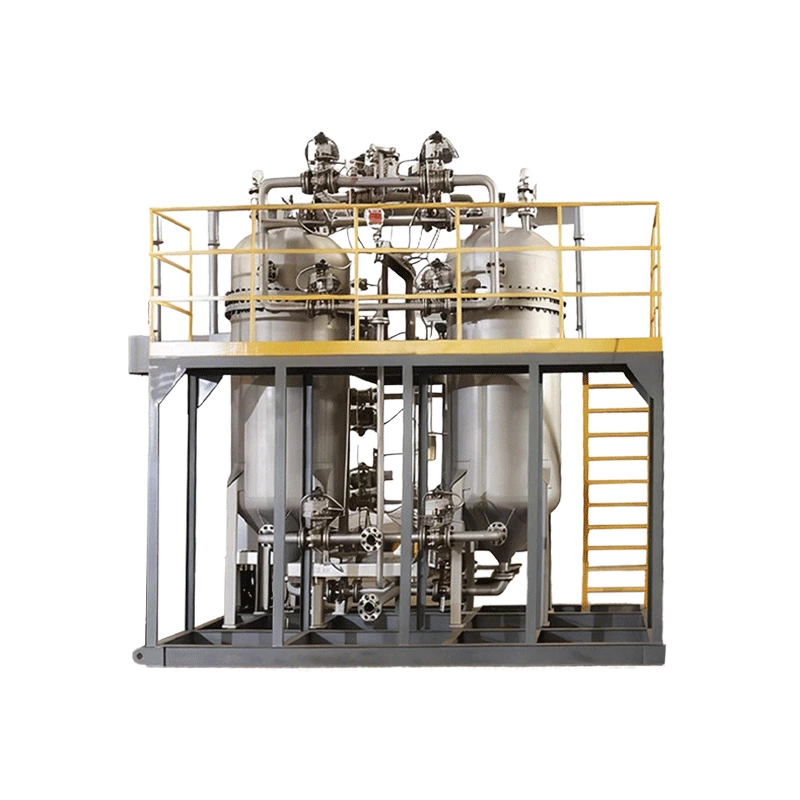
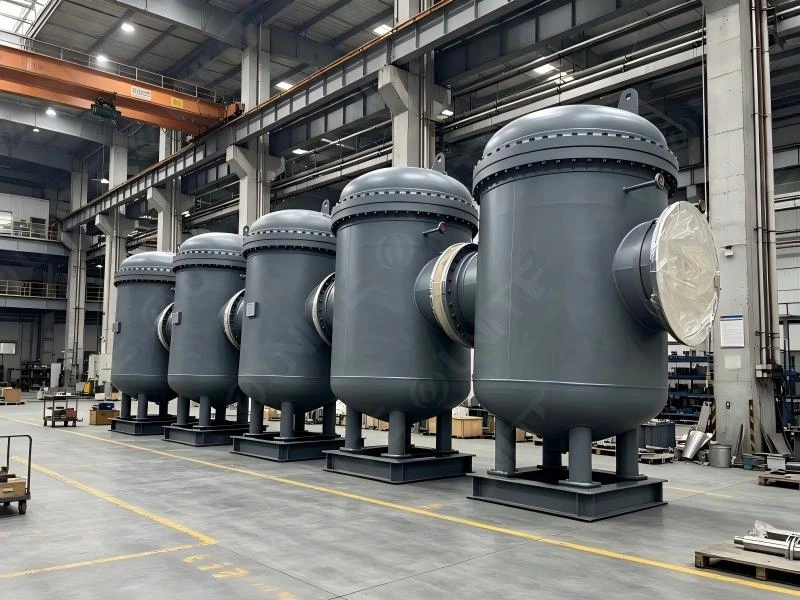
UNITE designed and manufactured multiple large-scale automatic candle filters for the project. The multi-lobed candle-element configuration increases available filtration area within a compact vessel and supports the formation of a controlled filter cake on the element surfaces.
During filtration, the slurry enters the closed filter housing under pressure. The liquid passes through the tubular candle elements and exits through the collection system, while calcium sulfate solids are retained on the outside of the elements and form a filter cake.
This operating principle is described in UNITE’s Candle Filter product page, which explains how tubular filter elements retain solids, form a cake, and support pressure filtration in a closed vessel.
2. Pressure Dewatering and Instantaneous Back-Pulse Cake Release
After the cake reaches the required thickness, the filtration vessel uses positive pressure to press additional liquid from the cake. Once the liquid phase has been sufficiently removed, the system initiates cake release.
An instantaneous back-pulse of gas expands and detaches the cake from the multi-lobed candle elements. The released solids then fall by gravity toward the lower cake outlet for collection or transfer to the next process step. This arrangement avoids manual removal of filter screens and supports a more controlled, enclosed discharge operation.
The exact back-pulse pressure, pulse duration, cake thickness, vessel pressure, and discharge sequence must be adjusted to the slurry’s solids concentration, particle-size distribution, cake permeability, and target residual moisture.
3. Displacement Washing with Reduced Wash-Water Demand
The system integrates multiple displacement-washing functions. Wash liquid is introduced in a controlled manner to displace the mother liquor retained within the filter cake and remove soluble impurities, including chloride ions.
Compared with uncontrolled washing, a properly designed displacement-washing sequence can improve impurity removal while limiting unnecessary wash-water consumption. The actual result depends on cake permeability, cake thickness, wash-liquid distribution, displacement ratio, wash temperature, slurry composition, and the required calcium sulfate purity.
The washing stage is particularly important for this project because the quality of the finished calcium sulfate depends not only on solid capture but also on the thoroughness and uniformity of impurity removal.
4. Automatic Dry-Cake Discharge
After pressure dewatering and back-pulse release, the system discharges the filter cake automatically. Operators do not need to disassemble the filter screens for routine cake removal.
The reported discharged cake has low moisture content and can proceed directly to the next process step, subject to the plant’s material-handling and quality requirements. Automatic discharge also helps improve the working environment by reducing manual handling of wet solids and limiting the need for frequent intervention around the filter vessel.
5. Customized PLC and Real-Time Process Monitoring
A customized PLC control system monitors pressure and flow in real time. The control logic coordinates feeding, filtration, washing, pressing, back-pulse release, discharge, and process transitions under multiple operating conditions.
The control system can use pressure, flow, liquid level, cake-thickness, and other process signals to maintain repeatable cycle operation. Alarm and interlock settings should be configured during commissioning based on the actual slurry behavior, vessel pressure, pump characteristics, wash-water availability, and downstream equipment requirements.
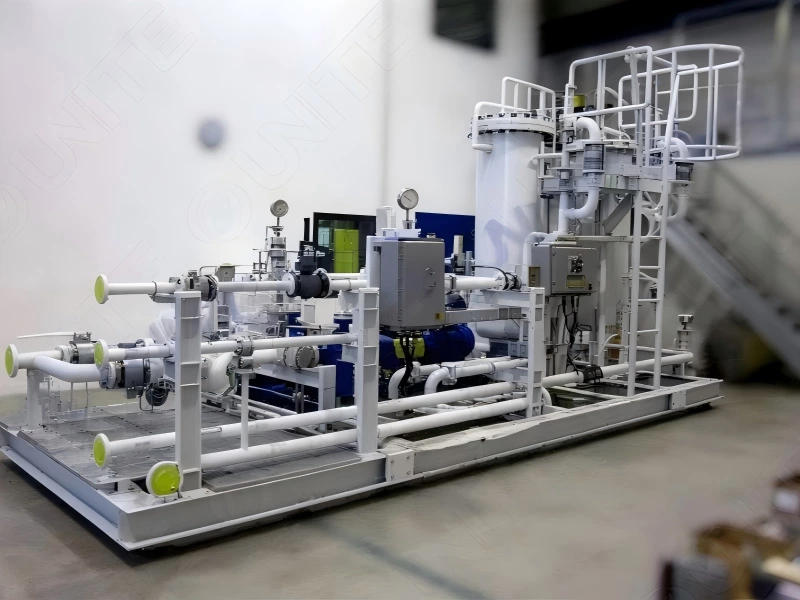
For integrated process packages, UNITE’s filtration and separation skid-mounted systems combine filtration equipment, valves, instrumentation, and control systems in a modular arrangement. The page also describes HMI-based process display and coordinated sequences for filtration, cleaning, drying, and discharge.
Reference Product Parameters
The following values are published reference ranges for UNITE’s candle-filter product family. They are not guaranteed values for every calcium sulfate application or every installed project configuration.
| Parameter | Published reference information | Selection note |
| Filtration precision | 0.2–100 μm, depending on filter element and functional design | Select according to particle-size distribution, filtrate target, and cake permeability. |
| Standard design pressure | 0.6, 1.0, 1.6, or 2.0 MPa; higher pressures can be customized | Confirm filtration, pressing, back-pulse, and code requirements. |
| Maximum design temperature | 0–300°C | Confirm slurry temperature, seals, lining, and thermal cycling. |
| Flow-rate range | 10–300 m³/h | Final capacity depends on slurry solids concentration and cycle time. |
| Filtration area | 0.9–150 m²; larger sizes can be customized | Size according to annual output, batch volume, cake thickness, and duty cycle. |
| Filter-element materials | PVDF, PTFE, PPS, PP, titanium, and other options | Select for slurry chemistry, abrasion, temperature, and cleaning method. |
| Back-blow pressure difference | 0.2–0.3 MPa | Confirm with cake-release tests and vessel-pressure limits. |
| Control system | PLC | Define signals, interlocks, recipes, alarms, and data-recording requirements. |
| Housing materials | 304, 316L, carbon steel, duplex steel, titanium; special materials can be customized | Confirm corrosion and abrasion conditions. |
For the complete published range and engineering details, see the Solid-Liquid Separation Series. Final sizing requires laboratory or pilot testing using representative calcium sulfate slurry.
Customer Value and Project Results
The project has been completed and placed into trial production. The client reported the following results:
•Improved filter-cake washing: The displacement-washing process significantly improved washing performance and impurity removal;
•Finished calcium sulfate quality above the stated industry benchmark: Product-quality indicators consistently exceeded the applicable industry standard during reported operation;
•Approximately 60% lower manual maintenance costs: Compared with traditional filtration equipment, the automatic system reduced manual maintenance expenditure by approximately 60%;
•Lower manual handling requirements: Automatic cake release and discharge reduced the need for manual screen disassembly and wet-solid handling;
•Improved production-environment conditions: Enclosed filtration and automatic discharge helped reduce the impact of manual solids handling on the operating area;
•Higher resource-utilization efficiency: The project supported the conversion of industrial byproducts into higher-value calcium sulfate products;
•Demonstration value for chemical byproduct utilization: The successful commissioning provided a reference solution for resource-based treatment of industrial byproducts in the chemical industry.
The approximately 60% maintenance-cost reduction and trial-production results are specific to this Jiangxi Salt Chemical project. Actual performance depends on slurry properties, operating cycle, maintenance baseline, labor costs, cake-washing requirements, and plant-management practices.
Why Candle Filters Suit This Application
Candle filters are a strong option when a process requires fine solid-liquid separation, enclosed operation, controlled cake formation, washing, pressure dewatering, and automated cake removal in one vessel. Relevant advantages for calcium sulfate production include:
1.Large filtration area in a compact vessel: Multi-element designs support high-throughput duty;
2.Closed operation: The vessel limits uncontrolled exposure of the slurry and reduces contamination risks;
3.Controlled cake formation: Cake thickness and pressure differential can be monitored as part of the filtration cycle;
4.Integrated washing and pressing: Displacement washing and positive-pressure dewatering can be coordinated in the same equipment;
5.Automatic cake release: Back-pulse gas can detach the cake without manual screen removal;
6.PLC-based repeatability: Automated sequences improve consistency between production cycles.
A candle filter is not automatically the best choice for every slurry. Pressure leaf filters, vacuum filters, filter presses, hydrocyclones, or other technologies may be more suitable depending on solids concentration, particle size, cake permeability, wash requirement, moisture target, throughput, and acceptable footprint. UNITE’s solid-liquid separation solutions can be evaluated against these process variables.
Conclusion
High-strength calcium sulfate production depends on reliable separation, effective cake washing, controlled moisture, and stable automated operation. For a 55,000 t/y resource-utilization project, the filtration system must handle abrasive and settling slurry while maintaining repeatable filtration cycles and reducing manual maintenance.
The Jiangxi Salt Chemical project combines multi-lobed candle elements, pressure dewatering, displacement washing, instantaneous back-pulse cake release, automatic dry-cake discharge, and customized PLC control. The result is a closed and highly automated solid-liquid separation solution that supports product quality, resource recovery, and improved operating efficiency.
If your application involves calcium sulfate, gypsum, salt-chemical byproducts, abrasive slurry, filter-cake washing, low-moisture cake discharge, or high-throughput automatic candle filtration, contact the UNITE engineering team with your slurry composition, solids concentration, particle size, flow rate, wash-water requirement, target cake moisture, and production cycle.
Related Pages
•Candle Filter for Fine Solid-Liquid Separation
•Solid-Liquid Separation Series
•Chemical-Industry Filtration and Separation Solutions
•Filtration and Separation Skid-Mounted Systems
•Jiangxi Salt Chemical Calcium Sulfate Project
•BASF Integrated Candle Filter and Three-in-One Filter Dryer Project