Pentair Group Project: High-Precision Filtration Solution for Water Injection Systems
Project Background: Protecting Reservoir Injectivity during Water Injection
Pentair is a global provider of water-treatment and process-filtration solutions. During secondary oil recovery, water injection is used to maintain reservoir pressure and support oil displacement. The injection water may come from seawater, produced water, surface water, or a blended source, depending on the field and treatment strategy.
The quality of injection water directly affects injectivity and reservoir permeability. Excessive suspended solids or fine particles can increase injection pressure, plug pore throats, damage the near-wellbore formation, and reduce the performance or service life of injection wells.
To address these risks, Pentair and its partners introduced highly reliable, fully automatic water-injection filtration units. The project is consistent with UNITE’s Eco Water Treatment solutions, which include high-flow automatic filtration for oil-and-gas water-injection processes and applications requiring continuous solids control.
Core Challenges
1. Reliability in Offshore and Remote Environments
Water-injection systems may be installed on offshore platforms or remote onshore sites where access is difficult and environmental conditions are demanding. The filter therefore needed robust mechanical construction, corrosion resistance, impact strength, suitable materials, and reliable unattended operation.
Seawater injection can be particularly challenging because chloride-rich water accelerates electrochemical corrosion. Produced water may also contain oil, suspended solids, scale particles, corrosion products, and residual treatment chemicals. The final material and coating system must be selected from actual water chemistry and site conditions.
2. Continuous High-Flow Operation
Injection operations commonly run continuously. The filtration system needed to provide high-throughput solids removal with controlled hydraulic loss while cleaning itself without stopping the main injection flow.
A shutdown during cleaning could affect injection pressure, field balance, and production continuity. Sequential cleaning of individual elements allows the filter to maintain service while addressing localized loading.
3. Strict Reservoir-Protection Requirements
The filter must remove particles relevant to the reservoir’s pore structure and injectivity limits. A nominal micron rating alone is not sufficient: particle-size distribution, particle shape, deformability, concentration, water chemistry, and the formation’s pore-throat distribution all influence the risk of plugging.
The final filtration target therefore needs to be established through formation-water analysis, injectivity testing, particle-size characterization, compatibility studies, and the operator’s water-quality specification.
Customized Solution: Large-Diameter Automatic Backwash Filtration
1. Parallel Multi-Element Configuration
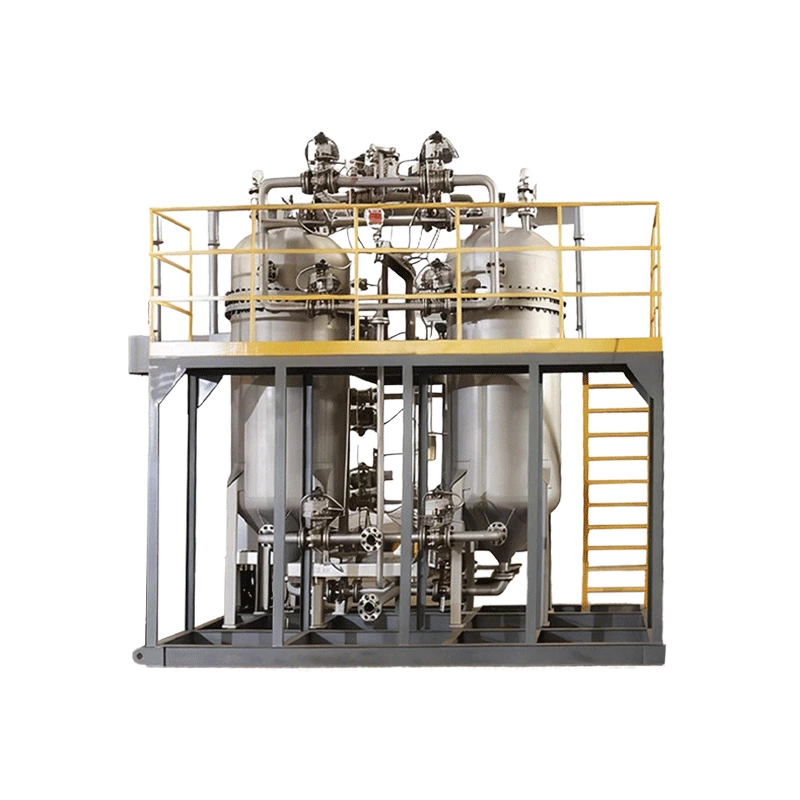
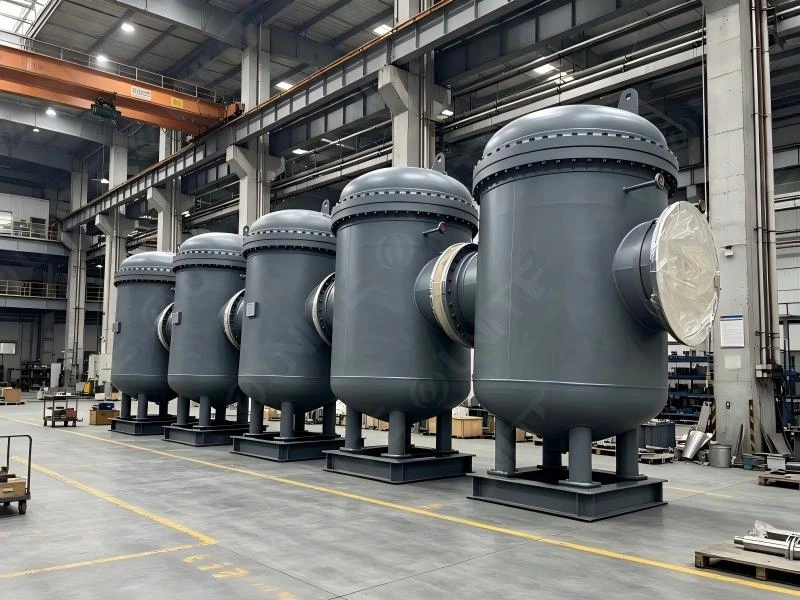
The system uses multiple filter elements arranged in parallel within a large-diameter vessel. This configuration provides a high effective filtration area and distributes the flow across several elements, allowing the unit to handle high injection-water throughput.
During normal filtration, particles are captured on the element surfaces while clean water continues toward the injection system. When loading causes the differential pressure to reach a configured setpoint, the control system initiates a sequential cleaning sequence.
The final number of elements, vessel diameter, filtration area, flow velocity, pressure drop, and redundancy arrangement should be determined from injection flow, solids loading, particle size, target water quality, and required availability.
2. Sequential Backwashing without Stopping Mainflow Injection
The automatic backwash sequence cleans individual element groups one at a time while the remaining elements continue filtering. Clean water flows in reverse through the selected element group, loosening and removing accumulated particles. The contaminants are then discharged through the drain outlet.
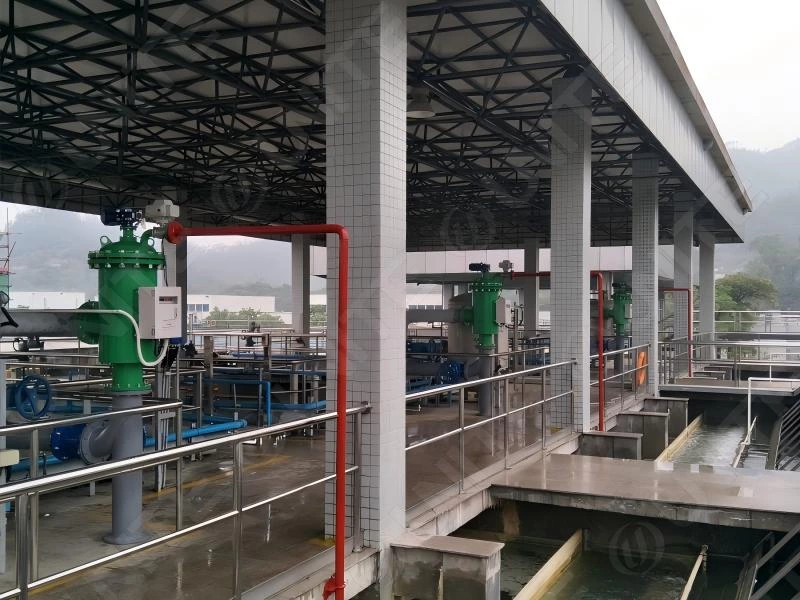
After the element group returns to an acceptable differential-pressure condition, the system moves to the next group or returns to normal filtration, depending on the programmed sequence. UNITE’s Automatic Backwash Filter describes this operating principle, including differential-pressure detection, sequential element cleaning, low backwash-water consumption, and automatic return to filtration.
The actual backwash flow, duration, pressure, sequence, and water loss must be verified against the injection-water quality, particle characteristics, vessel pressure, and disposal requirements.
3. Duplex Stainless Steel and Anti-Corrosion Protection
To address the corrosive nature of seawater injection and other challenging water sources, the vessels and internal components use Duplex stainless steel or advanced anti-corrosion coatings, depending on the project configuration.
Duplex stainless steel can provide a combination of strength and corrosion resistance, but the correct grade must be selected according to chloride concentration, temperature, oxygen content, pH, velocity, crevice conditions, pressure, welding method, and exposure duration. Coating systems require equivalent attention to surface preparation, lining compatibility, adhesion, damage resistance, inspection, and repair procedures.
The installed material should be confirmed from the approved equipment data sheet, material certificates, coating specification, and project quality dossier.
4. V-Shaped Wedge-Wire Screens
High-strength V-shaped wedge-wire screens provide controlled slot openings and a mechanically robust filtration surface. The continuous wedge-wire geometry can support uniform openings, effective solids retention, and resistance to clogging when correctly matched to the contaminant profile.
The screen slot size must be selected according to the reservoir-protection target rather than by a generic nominal value. Relevant design inputs include the particle-size distribution of the injection water, the proportion of deformable or fibrous solids, allowable pressure drop, well injectivity, and the required water-quality specification.
5. Back-Pulse Cleaning and Filter-Media Regeneration
In addition to reverse-flow backwashing, the system uses a powerful back-pulse mechanism to assist the release of accumulated contaminants from the filter surfaces. The pulse must be strong enough to remove the deposited solids without damaging the screens, seals, supports, coatings, or downstream equipment.
Back-pulse performance depends on pressure differential, pulse duration, air or water quality, contaminant adhesion, cake compressibility, and element geometry. These variables should be validated during factory testing and commissioning.
6. Digital Monitoring and Remote SCADA Integration
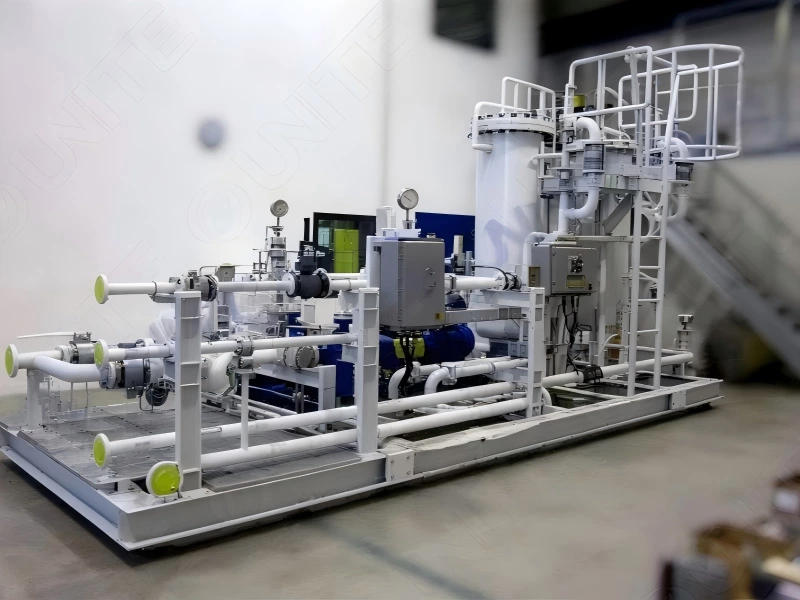
The intelligent control unit includes digital pressure and flow monitoring modules. These signals support differential-pressure tracking, backwash activation, alarm management, fault diagnosis, and operating-trend analysis.
The unit can connect to a remote SCADA system, enabling unattended or minimally attended operation. Operators can monitor injection-water flow, filter loading, cleaning status, alarms, and equipment health from the control room or remote operations center.
The final automation design should define signal lists, communication protocols, local/remote authority, alarm priorities, interlocks, emergency shutdown functions, cybersecurity requirements, and data retention. UNITE’s Self-Cleaning Filter Series provides broader context on continuous online cleaning, differential-pressure control, and automated operation in high-flow industrial applications.
Reference Product Parameters
The following values are published reference ranges for UNITE’s automatic backwash filter family. They are not guaranteed values for the Pentair project or for every oilfield water-injection application.
| Parameter | Published reference information | Selection note |
| Filtration precision | 20–3,000 μm | Select the screen opening from reservoir pore structure, particle distribution, and injectivity requirements. |
| Reference flow range | 10–5,000 m³/h | Confirm actual flow, turndown, peak flow, and required redundancy. |
| Reference temperature range | 0–90°C | Verify seawater or produced-water temperature and transient conditions. |
| Reference operating pressure | 0.6–2.5 MPa | Confirm pump discharge pressure, design pressure, backwash differential, and code requirements. |
| Cleaning method | Automatic reverse-flow backwash with sequential element cleaning | Final sequence depends on vessel design, element arrangement, and solids loading. |
| Control | Differential-pressure monitoring; adjustable backwash time; remote DCS/SCADA capability | Define site protocol, alarms, interlocks, and local/remote operation. |
| Screen configuration | Project-specific wedge-wire or other filter-element design | Confirm slot geometry, material, corrosion allowance, and mechanical strength. |
These are published reference values. Final equipment sizing requires water analysis, particle-size distribution, flow and pressure data, injection-well requirements, corrosion assessment, backwash-water availability, and disposal design.
Customer Value and Project Results
Since commissioning, the water-injection filtration system has delivered the following reported benefits:
•Stable average injection-well pressures: Filtered injection water supported stable well-pressure behavior during the reported operating period;
•No reservoir-clogging incidents attributed to water-quality fluctuations: The project reported zero such incidents after commissioning;
•More than 20% lower OPEX: The highly automated system reduced operating expenditure by more than 20% compared with traditional processes;
•Lower manual-maintenance frequency: Automatic sequential backwashing, monitoring, and fault diagnosis reduced the need for routine manual intervention;
•Reliable high-flow operation: The multi-element arrangement supported continuous injection service while individual element groups were cleaned;
•Strong customer evaluation: Pentair recognized the system’s stable performance and manufacturing quality, strengthening long-term cooperation in oil-and-gas water treatment.
The stable pressure, zero-clogging, and more-than-20% OPEX results are project-specific reported outcomes. Actual performance depends on reservoir properties, injection-water quality, particle distribution, flow rate, pressure, corrosion conditions, backwash settings, well completion, and operating practice.
Why Automatic Backwash Filtration Suits Water Injection
Automatic backwash filtration can be suitable for water injection when the system must remove suspended solids continuously while maintaining injection availability. Its value comes from several coordinated functions:
1.High effective filtration area: Parallel elements distribute high flow across the vessel;
2.Sequential online cleaning: Individual element groups can be cleaned while the rest remain in service;
3.Controlled pressure drop: Differential-pressure monitoring provides a basis for cleaning activation and fault detection;
4.Low manual intervention: Automatic backwashing and drain control reduce routine maintenance;
5.Reservoir-focused particle control: Screen selection can be aligned with formation and injectivity requirements;
6.Remote operation: Digital pressure and flow data can be integrated into SCADA or DCS systems.
Automatic filtration does not replace upstream oil removal, desalination, deoxygenation, biocide control, corrosion inhibition, or other water-treatment stages that may be required for a specific injection-water source. A complete water-injection treatment train should address chemical, biological, and particulate risks together.
Conclusion
Water injection is a critical part of secondary oil recovery, but particulate contamination can threaten injectivity, increase well pressure, and reduce reservoir performance. Offshore and remote installations also require filtration equipment that can operate continuously, withstand corrosion, and minimize manual maintenance.
The Pentair project combines large-diameter multi-element filtration, sequential automatic backwashing, Duplex stainless-steel or coated construction, V-shaped wedge-wire screens, back-pulse regeneration, and SCADA-connected monitoring. The reported results demonstrate how a carefully engineered automatic backwash system can support stable water-injection operation, reservoir protection, and lower operating costs.
If your application involves seawater injection, produced-water injection, surface-water treatment, secondary oil recovery, reservoir protection, high-flow solids removal, or remote SCADA-managed filtration, contact the UNITE engineering team with your water analysis, particle-size distribution, flow rate, pressure, formation data, corrosion conditions, and target injection-water quality.
Related Pages
•Eco Water Treatment Solutions
•Automatic Suction-type Filter
•Oil-Refining Filtration and Separation Solutions
•Pentair Water-Injection Filtration Project