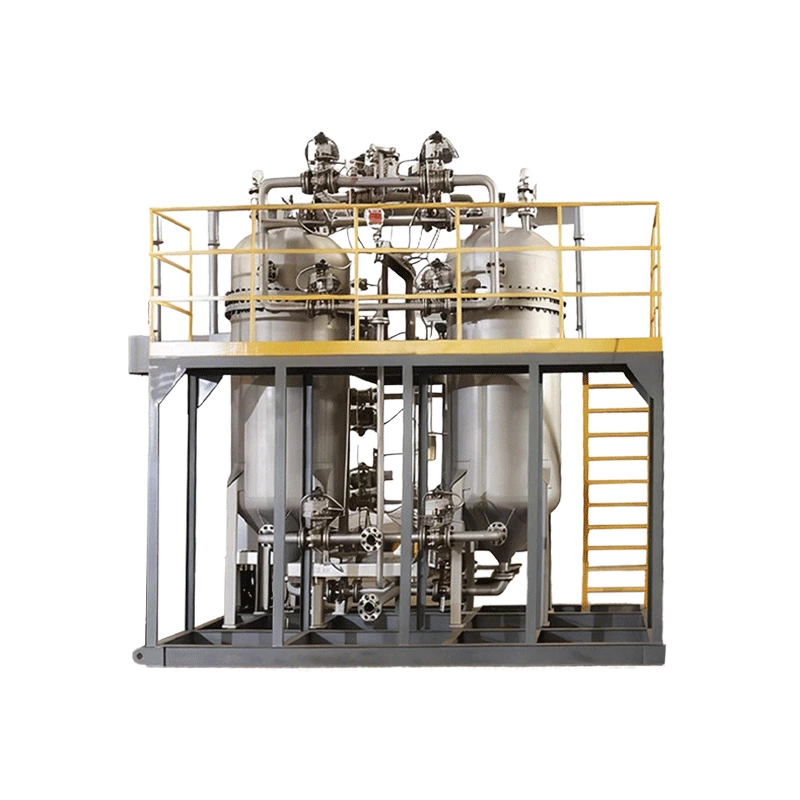
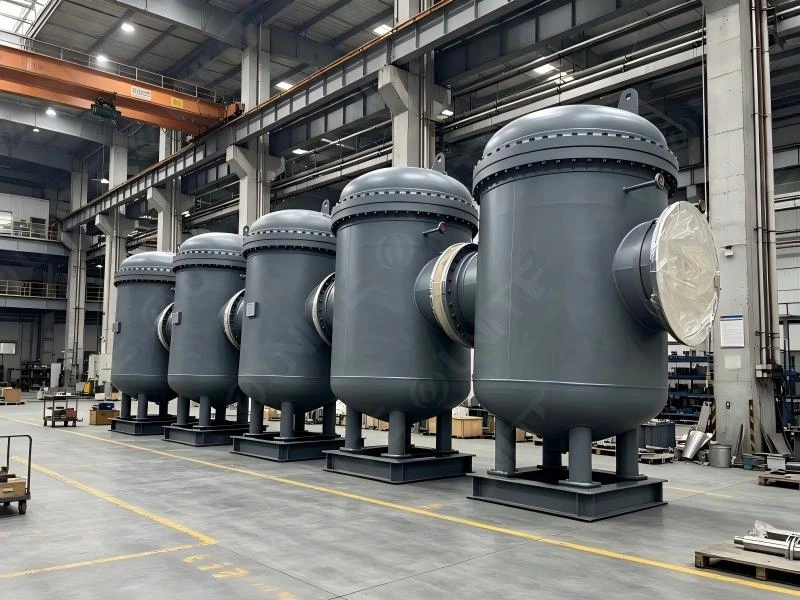
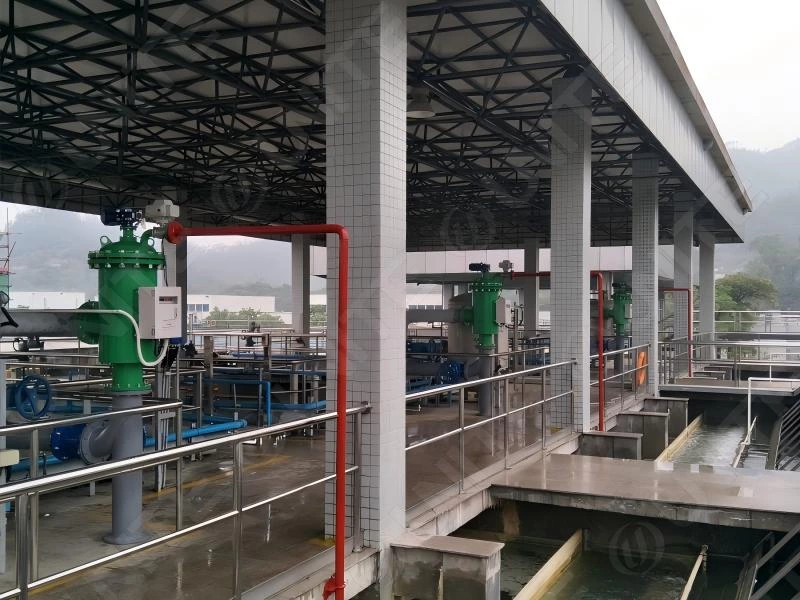
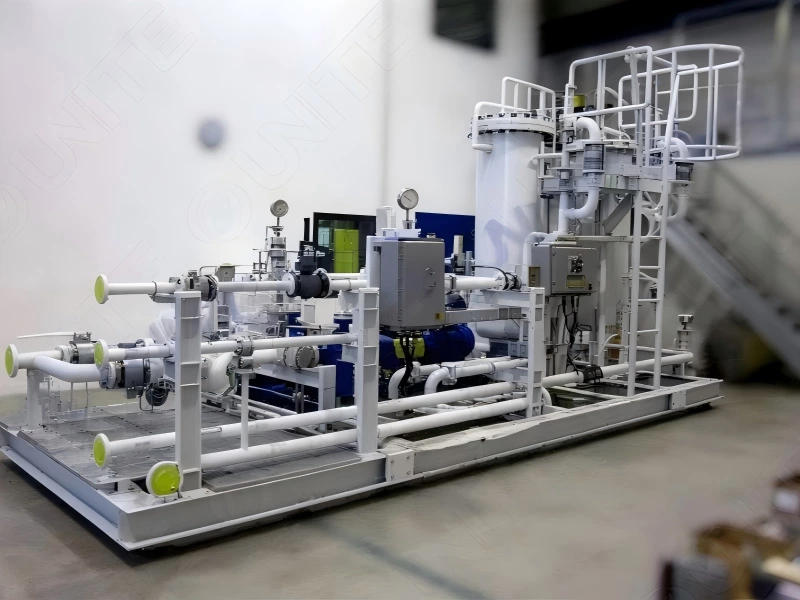
Dalian Development Zone Jingmao Co. Project: Fully Automatic Filtration System for Chemical Plant Circulating Water Reuse
Project Background: Improving Cooling-Water Reuse in a Chemical Plant
A prominent Japanese-invested trading company in the Dalian Development Zone supplies environmental and fluid-treatment equipment to international chemical-industry customers. In this project, the end user—a large-scale chemical plant—needed to purify and reuse high-flow circulating cooling water generated during production.
Circulating cooling water can accumulate sediment, rust, algae, and other suspended solids. If these contaminants remain in the loop, they may reduce heat-transfer efficiency, promote heat-exchanger scaling, increase corrosion risk, and contribute to unplanned cleaning or maintenance interruptions.
Because the equipment was intended for export to Japan and other international markets, the project also required robust manufacturing quality, reliable automation, corrosion protection, and stable long-term operation. The solution supports the objectives described in UNITE’s Eco Water Treatment solutions, including side-stream filtration for circulating cooling-water systems, suspended-solids removal, heat-exchanger protection, and water-resource recycling.
Core Challenges
1. Continuous Filtration without Interrupting Production
Chemical plants commonly operate 24/7. The filter therefore needed to clean its screen and discharge accumulated contaminants without stopping the main cooling-water flow or interrupting downstream users.
2. Export-Level Manufacturing and Quality Control
As an international export project, the equipment needed consistent control of vessel fabrication, welding quality, surface treatment, instrumentation, control precision, inspection, assembly, and factory testing. Reliability during installation, commissioning, and long-term operation was a key requirement.
3. Variable and Seasonal Impurity Loading
The circulating water contained multiple contaminant types, including sediment, rust, and algae. Seasonal algae outbreaks could change the solids loading and cleaning demand. The system therefore needed adaptable cleaning logic, sufficient dirt-holding capacity, and reliable blowdown performance.
4. Remote Monitoring and Central-Control Integration
The end user required high automation with real-time operational feedback and communication with the plant’s central control room. Operators needed visibility of differential pressure, cleaning status, alarms, and key operating parameters without routine manual inspection at the filter.
Customized Solution: Modular Automatic Self-Cleaning Filtration Unit
1. Stainless-Steel Wedge-Wire Screen Filtration
The unit uses high-precision stainless-steel wedge-wire screens to retain suspended solids, rust particles, sediment, and algae-related debris while allowing clarified cooling water to continue through the process.
Wedge-wire screens provide a defined opening geometry and a mechanically robust filtration surface. The final screen opening should be selected according to the cooling-water quality target, flow rate, particle-size distribution, pressure drop, and downstream heat-exchanger protection requirement.
For related equipment selection, see UNITE’s Self-Cleaning Filter Series, which covers automatic online cleaning and backwashing for high-flow and continuous industrial applications.
2. Suction or Brush Self-Cleaning Mechanism
The project solution uses a motor-driven cleaning mechanism described in the source material as suction/brush self-cleaning. When the pressure differential reaches a preset threshold, the cleaning mechanism activates automatically and removes accumulated impurities from the screen surface within seconds while the main filtration process continues.
The exact installed configuration—brush-type, suction-scanning, or a combined design—should be confirmed from the final project drawings. UNITE’s Automatic Brush Self-Cleaning Filter uses a rotating brush to clean the screen and open an automatic drain valve, while the Automatic Suction-type Filter uses a moving suction scanner and localized reverse flow to remove debris with low water consumption.
Both approaches are designed for continuous filtration during cleaning. The correct mechanism depends on screen precision, solids type, algae characteristics, water temperature, flow rate, pressure, and allowable blowdown volume.
3. Automatic Blowdown with Low Water Consumption
During the cleaning cycle, the filter isolates or locally cleans the contaminated screen area and opens the automatic drain or blowdown valve. The removed solids are discharged from the system, after which the unit returns to normal filtration.
Low-water-consumption cleaning is valuable in a cooling-water reuse application because excessive blowdown can increase makeup-water demand, chemical consumption, and wastewater volume. The actual blowdown loss depends on drain-valve size, cleaning duration, pressure, solids loading, and the selected cleaning mechanism.
4. Multi-Mode PLC Control and Touchscreen Monitoring
The integrated PLC cabinet supports three trigger modes: differential pressure, timer, and manual operation. Differential-pressure control initiates cleaning when screen loading causes the pressure differential to reach the configured threshold. Timer control can provide scheduled cleaning, while manual mode supports commissioning, inspection, and maintenance.
Operating parameters are displayed on a touchscreen in real time. The system also supports remote communication protocols so that operating status, alarms, cleaning cycles, and process trends can be transmitted to the plant’s central control room.
The final control architecture should define sensor ranges, alarm levels, cleaning interlocks, drain-valve logic, communication protocol, remote/local authority, emergency-stop functions, and data-recording requirements.
5. Industrial-Grade Corrosion and Wear Resistance
Because circulating water in a chemical plant may contain chloride ions, treatment chemicals, biological activity, and abrasive solids, the filter vessel received specialized anti-corrosion treatment. The internal core components use wear-resistant and corrosion-resistant alloy materials selected for the project conditions.
Material selection must consider water chemistry, chloride concentration, pH, temperature, chemical dosing, erosion velocity, cleaning frequency, coating compatibility, and inspection requirements. The final material and coating system should be confirmed through the project design basis and site water analysis.
6. Export-Compliant Manufacturing and Testing
The equipment was assembled and tested according to export-quality requirements. This approach supports reliable transportation, installation, commissioning, and long-term operation for international customers.
Export compliance is not limited to appearance or documentation. It may include material certificates, welding procedures and records, dimensional inspection, pressure testing, coating inspection, electrical testing, PLC functional testing, factory acceptance testing, spare-parts documentation, and operating manuals. The applicable standards and certification scope should be confirmed for the destination market and end user.
Reference Product Parameters
The following published values are reference ranges for relevant UNITE self-cleaning filter families. They are not guaranteed values for the Dalian project or for every cooling-water application.
| Filter family | Filtration precision | Reference flow range | Reference temperature | Reference pressure | Cleaning principle |
| Automatic Brush Self-Cleaning Filter | 50–5,000 μm | 20–2,500 m³/h | 0–80°C | 0.6–1.6 MPa | Motor-driven rotating brush and automatic drain |
| Automatic Suction-type Filter | 10–500 μm | 10–1,200 m³/h | 0–70°C | 0.4–1.6 MPa | Moving suction scanner and localized reverse flow |
| Automatic Backwash Filter | 20–3,000 μm | 10–5,000 m³/h | 0–90°C | 0.6–2.5 MPa | Automatic reverse-flow backwashing |
The project’s final screen opening, operating temperature, flow rate, pressure rating, blowdown volume, and cleaning cycle should be confirmed from the approved equipment data sheet. For a cooling-water loop, selection should also consider heat-exchanger approach temperature, suspended-solids loading, algae seasonality, corrosion-control chemistry, makeup-water quality, and allowable side-stream flow.
Customer Value and Project Results
Following export, commissioning, and operation of the system, the project delivered the following reported benefits:
•Improved circulating-water clarity: Automatic removal of sediment, rust, algae, and suspended solids improved the visual and operating quality of the chemical plant’s cooling water;
•More than 50% longer heat-exchanger cleaning and maintenance cycles: Better solids control reduced the rate of fouling and extended the interval between cleaning activities by more than 50%;
•Reduced unplanned downtime: Continuous self-cleaning operation reduced the need to interrupt the cooling-water circuit for routine filter cleaning;
•Zero manual intervention for automatic blowdown: The PLC-controlled cleaning and discharge sequence operated automatically under the project’s reported conditions;
•Progress toward a digital green factory: Remote monitoring and automated operation supported reduced manual intervention and more data-driven water-system management;
•Strong export-project evaluation: The Dalian trading company recognized UNITE’s equipment quality and response speed, leading to further cooperation intentions for international export projects.
The reported extension of maintenance cycles by more than 50% and zero-manual-intervention result are specific to this project. Actual performance depends on cooling-water chemistry, solids and algae loading, screen precision, flow rate, temperature, pressure, cleaning settings, heat-exchanger design, and site maintenance procedures.
Why Self-Cleaning Filtration Suits Cooling-Water Reuse
Self-cleaning filters are suitable for cooling-water systems when suspended solids must be removed continuously without stopping the circulation loop. Their practical value comes from several features:
1.Online cleaning: The screen can be cleaned while the main water flow continues;
2.Automatic trigger logic: Differential pressure and timer modes respond to changing contaminant loading;
3.Low manual workload: Automatic drain or blowdown reduces routine screen removal and manual cleaning;
4.Adaptability to variable water quality: The system can be configured for sediment, rust, algae, and mixed suspended solids;
5.Protection of heat exchangers and pumps: Better solids control can reduce fouling, erosion, and maintenance pressure;
6.Integration with plant control: PLC and remote communication support centralized monitoring and digital operation.
Self-cleaning filtration is not a complete substitute for biocide management, corrosion inhibition, side-stream treatment, chemical dosing, or advanced water purification where those controls are required. The full cooling-water-management program should address biological, chemical, and particulate contamination together.
Conclusion
High-flow cooling-water reuse in chemical plants requires stable filtration, automatic cleaning, low water loss, corrosion resistance, and integration with the plant control system. Manual filters or systems that require shutdown for cleaning can create unnecessary maintenance and production risks in 24/7 operations.
The Dalian Jingmao project combines stainless-steel wedge-wire screening, suction or brush self-cleaning, automatic blowdown, differential-pressure and timer control, PLC monitoring, remote communication, corrosion-resistant materials, and export-compliant manufacturing. The reported result was a significant extension of heat-exchanger maintenance cycles and a transition toward lower-intervention, digitally managed cooling-water operation.
If your application involves chemical-plant cooling water, high-flow side-stream filtration, sediment and rust removal, algae control, heat-exchanger protection, automatic blowdown, or export-quality filtration equipment, contact the UNITE engineering team with your flow rate, water analysis, screen precision, temperature, pressure, solids loading, and cleaning requirements.
Related Pages
•Eco Water Treatment Solutions
•Automatic Brush Self-Cleaning Filter
•Automatic Suction-type Filter