Ashland Project: Precision HCl Filtration System for Specialty Chemical Lines
Project Background: Protecting Specialty-Chemical Synthesis from HCl Contamination
Ashland is a global specialty-chemical company whose products serve industries including pharmaceuticals, personal care, and architectural coatings. In the production of a high-performance intermediate, large quantities of industrial hydrochloric acid (HCl) are used as a reaction reagent.
Raw HCl can contain trace quantities of rust, pipe debris, and insoluble particles introduced during transportation, transfer, or storage. If these contaminants enter the reactor, they may poison or deactivate catalysts, increase fouling, and affect the color and purity of the final product.
To protect the reaction process and maintain consistent product quality, Ashland selected UNITE’s corrosion-resistant precision filtration system. The application reflects the priorities described in UNITE’s chemical-industry filtration solutions, which focus on high-purity processing, catalyst protection, corrosive-media handling, process safety, and reliable operation under demanding conditions.
Core Challenges
1. Severe Hydrochloric-Acid Corrosion
Hydrochloric acid is highly aggressive toward many conventional metallic materials. Standard 304 or 316L stainless steel may be unsuitable for the specific HCl concentration, temperature, and exposure conditions. The filtration equipment therefore required a carefully selected non-metallic wetted-surface design and reliable protection of the pressure-containing structure.
2. Strict Cleanliness Requirements
Specialty-chemical reactions are sensitive to trace impurities. The filtration system needed to stably intercept fine particles larger than approximately 1–5 μm, according to the project requirements, while maintaining chemical compatibility, acceptable pressure drop, and consistent filtrate quality.
3. Hermetic Leak Prevention
HCl is volatile, toxic, and corrosive. Any leakage could create personnel-safety, environmental, equipment-integrity, and production risks. The filtration unit therefore required hermetic operation under pressure, with suitable sealing materials and a design that minimized potential exposure points.
4. Safe and Efficient Maintenance
Filter-element or filter-bag replacement had to be fast and straightforward. A quick maintenance procedure reduces operator exposure to strong acid, limits production interruption, and supports safer routine servicing.
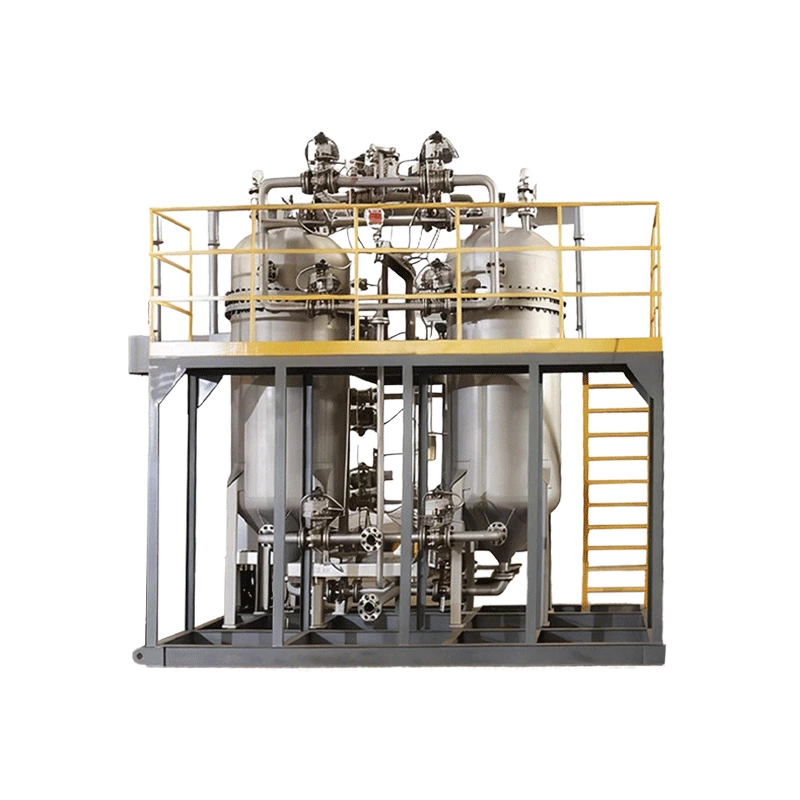
Customized Solution: Fully PTFE/PFA-Lined Precision Filtration Skid
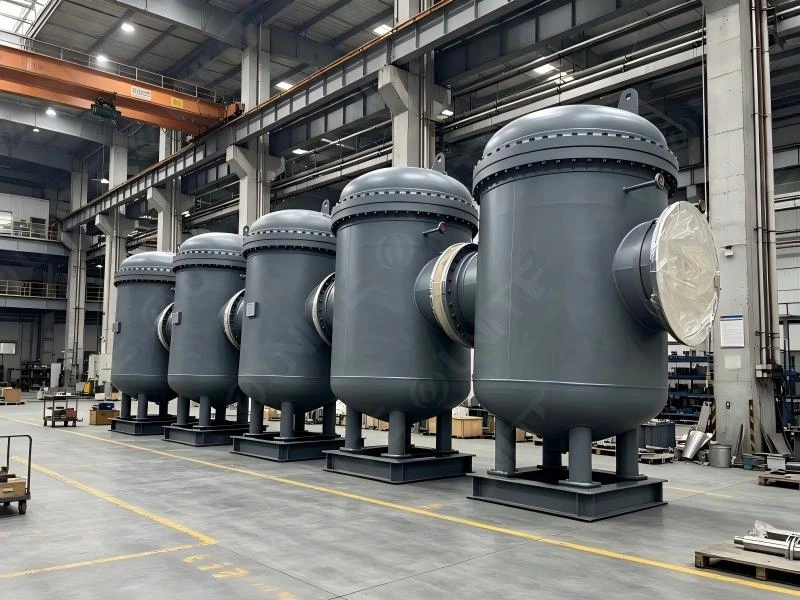
1. PTFE/PFA-Lined Filter Vessel and Non-Metallic Wetted Surfaces
The filter vessel is constructed from high-strength carbon steel with a thick PTFE or PFA lining. The lining creates a corrosion-resistant barrier between the HCl and the structural metal shell. Wetted components are designed with non-metallic materials to minimize corrosion and reduce the risk of metal-ion contamination entering the process stream.
This design approach is intended for the project’s specified HCl conditions. Final lining thickness, permeation resistance, temperature limit, vacuum resistance, flange design, spark or continuity requirements, and inspection method must be confirmed against the actual acid concentration, temperature, pressure, and applicable chemical-equipment standards.
2. High-Performance Non-Metallic Filter Elements
The system uses precision depth filter elements or bags manufactured from polypropylene (PP) or PTFE. These materials provide chemical compatibility with the specified strong-acid service while offering high impurity-retention capacity.
The depth-filtration arrangement helps capture rust, pipe debris, and insoluble particles before the HCl enters the reactor. The final media selection should be based on particle-size distribution, acid concentration, temperature, flow rate, differential pressure, extractables, and the required filtrate-cleanliness target.
For additional information about UNITE’s solid-liquid separation equipment, see the Solid-Liquid Separation Series, which includes precision filtration systems designed for chemical, pharmaceutical, environmental, and other demanding process applications.
3. Hermetic, Leak-Resistant Closure Design
The filtration unit uses flanged lids with specialty perfluoroelastomer (FFKM) or encapsulated O-rings to maintain a reliable seal during pressurized operation. The sealing arrangement is designed to prevent HCl leakage and reduce the potential for vapor release during normal filtration and maintenance isolation.
Hermetic integrity depends not only on the gasket material but also on flange alignment, surface finish, bolt loading, thermal cycling, pressure rating, inspection, and correct installation. These factors should be verified during factory testing, site commissioning, and periodic maintenance.
UNITE’s filtration systems also emphasize enclosed operation and leak prevention. The solid-liquid separation product series highlights sealed connections, quick-opening components, and process-skid design for stable operation and improved maintenance efficiency.
4. Modular Anti-Corrosive Skid Integration
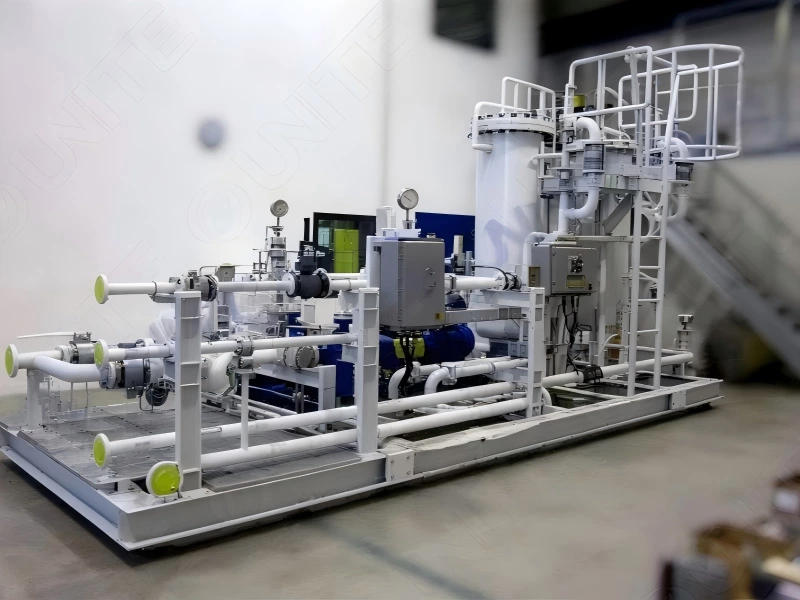
The filtration unit is supplied as a modular anti-corrosive skid that integrates acid-resistant diaphragm pressure gauges, corrosion-resistant sampling valves, piping interfaces, and overall protective coating. The skid-mounted format supports faster on-site connection and provides a coordinated arrangement for process isolation, monitoring, sampling, and maintenance.
This integrated approach is consistent with UNITE’s filtration and separation skid-mounted systems, which combine filters, piping, valves, instrumentation, control systems, and support components in a compact package. The final skid configuration can be customized according to process flow, materials, filtration precision, pressure rating, automation level, and installation requirements.
5. Maintenance-Oriented Configuration
The system is arranged to simplify filter-element or bag replacement and reduce the time operators spend near the HCl service. Isolation, depressurization, draining, flushing, ventilation, and acid-neutralization procedures must be completed according to the site’s approved operating and hazardous-material procedures before the filter housing is opened.
A safe maintenance program should include chemical-resistant personal protective equipment, lockout/tagout, written work permits, residual-acid verification, appropriate spill control, and inspection of liners, gaskets, closures, and instruments after each service interval.
Customer Value and Project Results
Since the HCl filtration system was commissioned at Ashland, the project has delivered the following reported benefits:
•Two-grade improvement in acid-particle indicators: Testing showed a significant improvement in the cleanliness indicators for the filtered acid;
•Reduced downstream reactor fouling: More effective removal of rust, pipe debris, and insoluble particles reduced contaminant deposition in the reactor;
•Lower catalyst loss: Cleaner HCl feed helped reduce the risk of catalyst poisoning and contamination-related catalyst loss;
•Stable long-term corrosion performance: The fully PTFE-lined design reportedly operated for multiple years without corrosion leakage;
•Lower environmental and maintenance costs: Reduced leakage risk, less downstream fouling, and more stable operation helped lower environmental O&M costs;
•Positive customer evaluation: Ashland recognized UNITE’s expertise in handling highly corrosive fluids and considered the project a reference for similar production-line upgrades across its global network.
The reported two-grade improvement in acid-particle indicators and the multi-year zero-corrosion-leakage result are specific to this Ashland project. Actual performance depends on HCl concentration, temperature, pressure, particle loading, filter-media selection, lining condition, sealing practice, maintenance procedures, and measurement methodology.
Conclusion
Precision filtration of hydrochloric acid requires more than fine particle removal. The system must withstand severe chemical attack, prevent leakage, protect the reaction process from trace impurities, and allow maintenance without unnecessary operator exposure.
The Ashland project combines PTFE/PFA-lined construction, non-metallic PP or PTFE filter elements, hermetic FFKM or encapsulated O-ring sealing, acid-resistant instrumentation, and modular skid integration. By controlling particulate contamination before the HCl enters the reactor, the solution helps protect catalysts, reduce reactor fouling, preserve product color and purity, and improve the safety and reliability of specialty-chemical production.
If your application involves hydrochloric acid, strong-acid filtration, catalyst protection, specialty chemicals, non-metallic filter elements, PTFE/PFA lining, or hermetic corrosive-fluid handling, contact the UNITE engineering team with your acid concentration, temperature, pressure, flow rate, particle profile, and required filtration precision.
Related Pages
•Chemical-Industry Filtration and Separation Solutions
•Solid-Liquid Separation Series
•Filtration and Separation Skid-Mounted Systems
•Ashland HCl Precision Filtration Project