DuPont Project: Integrated Ultrafiltration (UF) System for Melamine Production
Project Background: Recovering Value from Melamine Mother Liquor
DuPont is a global producer of specialty materials and chemicals with stringent requirements for production efficiency, product consistency, and environmental performance. During melamine production, the mother liquor remaining after crystallization may still contain fine particles and partially converted intermediates.
Traditional sedimentation and conventional dead-end mechanical filtration can struggle to retain sub-micron particles while maintaining the flow required for continuous production. As a result, valuable material may be lost and the mother liquor may not be suitable for high-quality recycling.
To improve resource utilization and support its global EHS objectives, DuPont introduced a high-precision ultrafiltration system for melamine-process treatment. The project aligns with UNITE’s chemical-industry filtration solutions, which address high-purity processing, resource recovery, solid-liquid separation, wastewater reduction, and protection of downstream equipment.
Core Challenges
1. Elevated Temperature and Chemical Complexity
Melamine mother liquor is processed at elevated temperatures and can contain ammonia, carbon dioxide, fine melamine particles, and other process constituents. The membrane system therefore needed suitable thermal stability, chemical compatibility, dimensional stability, and resistance to swelling or degradation under the actual operating conditions.
2. Membrane Fouling and Flux Decline
Melamine particles can deposit on the membrane surface and form a fouling layer. If the layer becomes too thick, transmembrane resistance increases and permeate flux declines. Without an effective cleaning and monitoring strategy, the system may require frequent shutdowns or lose its ability to operate continuously.
3. Sub-Micron Separation at High Flow
The system needed to retain sub-micron suspended solids while maintaining sufficient throughput and filtrate clarity for recycling. This required coordinated selection of membrane material, pore or cut-off characteristics, cross-flow velocity, transmembrane pressure, recirculation rate, and cleaning frequency.
4. Safety, Corrosion Control, and Plant Integration
The system had to conform to DuPont’s rigorous industrial-safety and corrosion-control expectations. Sensors, alarms, control logic, and real-time data transmission also needed to integrate with the plant’s distributed control system (DCS).
Customized Solution: Fully Automated, Heat-Resistant UF System
1. Project-Specific High-Temperature Membrane Modules
UNITE selected specially modified polymer or ceramic membrane modules for the DuPont application. The selected modules were intended to operate stably in a high-temperature and chemically complex mother-liquor environment without unacceptable swelling, embrittlement, or performance loss.
The DuPont case identifies modified polymer or ceramic membranes as the project solution. This should not be read as a universal material specification for every UNITE UF application. Final membrane selection must consider temperature, pH, ammonia and carbon-dioxide exposure, particle loading, chemical cleaning agents, pressure, permeability, mechanical strength, and the required separation target.
For comparison, UNITE’s published Cross-flow Filtration System page describes membrane-based cross-flow separation and lists metal membrane options such as stainless steel, titanium, and Hastelloy. These published options are reference information; they do not replace project-specific membrane selection or compatibility testing.
2. Cross-Flow Filtration to Control Fouling
The system operates in cross-flow mode. Instead of forcing the entire feed directly through the membrane surface, most of the feed travels tangentially along it. The high-velocity flow generates shear that helps sweep away deposited particles and reduces the formation of a compact fouling layer.
A portion of the liquid passes through the membrane as permeate, while retained solids remain in the circulating stream for recovery or controlled handling. This arrangement supports longer operating cycles, more stable flux, and lower cleaning frequency than a comparable dead-end configuration when the feed contains significant suspended solids.
UNITE describes cross-flow filtration as suitable for continuous operation, fine-particle separation, high-solids handling, and applications where valuable solids should be retained. The final design must be sized using actual mother-liquor viscosity, solids concentration, particle-size distribution, temperature, flow rate, transmembrane pressure, and recovery target.
3. Automated CIP for Flux Recovery
The integrated clean-in-place system initiates chemical-cleaning procedures based on differential-pressure feedback. When the pressure differential indicates increasing membrane resistance or fouling, the control system can trigger a defined CIP sequence to restore membrane performance.
A typical CIP strategy may include isolation, draining or displacement, chemical circulation, soaking, rinsing, and return to service. The actual chemistry and sequence must be established through compatibility testing because membrane material, seals, deposits, temperature, concentration, and cleaning duration all affect membrane life and cleaning effectiveness.
Automated CIP reduces reliance on manual intervention and supports unattended or minimally attended operation. It also improves process repeatability by applying defined cleaning conditions rather than relying solely on operator judgment.
4. Differential-Pressure and Process Monitoring
Precision sensors monitor key operating conditions, including pressure differential across the membrane system. These data support fouling detection, CIP initiation, alarm management, and performance trending.
Monitoring should also consider feed pressure, permeate pressure, recirculation flow, temperature, conductivity or composition where appropriate, tank levels, valve status, and CIP sequence status. The final instrumentation list should be confirmed against the plant control philosophy and the process-safety review.
5. DCS Communication and Safety Integration
The system includes real-time data-transmission modules for communication with the plant’s DCS. This allows operating status, alarms, process trends, and cleaning events to be viewed within the broader production-control environment.
The integrated design follows DuPont’s stated requirements for industrial safety and corrosion control. The final implementation should define signal lists, communication protocols, permissives, emergency-stop logic, interlocks, equipment isolation, chemical-cleaning safeguards, and cybersecurity requirements in accordance with the site’s approved standards.
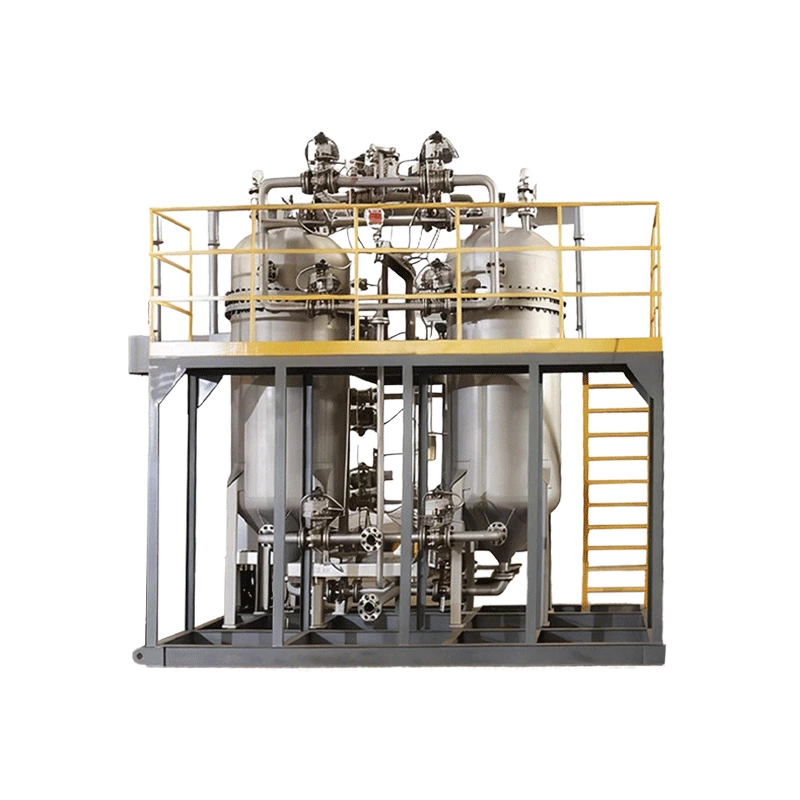
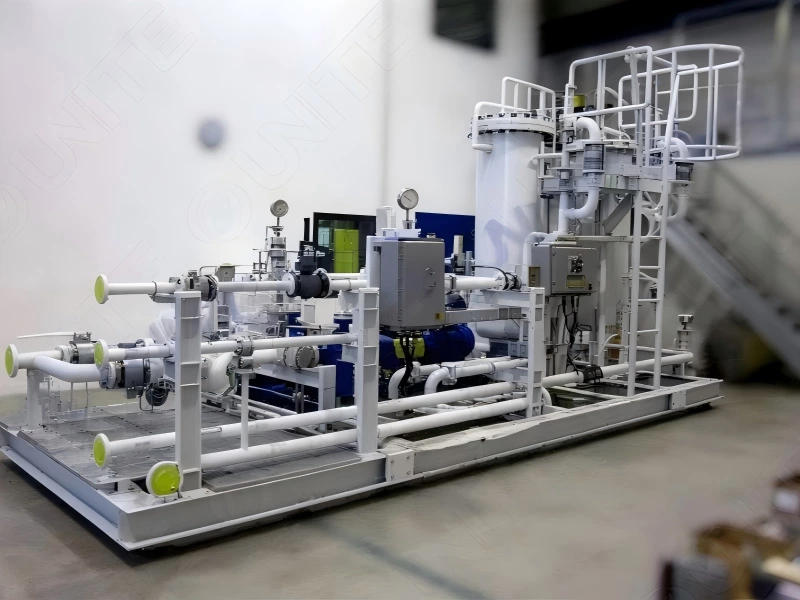
For projects requiring an integrated equipment package, UNITE’s filtration and separation skid-mounted systems combine filtration units, piping, valves, instrumentation, control systems, and modular process integration. The system page also describes HMI-based process display and customized PLC or DCS control arrangements.
Published Reference Parameters for Cross-Flow Filtration
The following values are published reference ranges for UNITE’s cross-flow filtration system. They are not guaranteed values for the DuPont project or for every melamine mother-liquor application.
| Parameter | Published reference information | Selection note |
| Membrane material | 316L/304 stainless steel, titanium, Hastelloy, and other project-specific options | The DuPont case identifies modified polymer or ceramic modules; confirm the installed material separately. |
| Typical filtration accuracy | 0.05–100 μm for 316L/304; 0.1–50 μm for titanium; 0.5–20 μm for Hastelloy | Select according to the target particle distribution and recycling quality. |
| Transmembrane pressure (TMP) | 0.1–0.8 MPa | Excessive TMP may accelerate fouling; final value requires process testing. |
| Cross-flow velocity | 3–8 m/s | Balance shear, energy consumption, membrane stress, and fouling control. |
| Operating temperature | −20–400°C, depending on material and configuration | Do not apply the full range to polymer or ceramic modules without confirmation. |
| pH tolerance | 0–14, depending on material | Confirm ammonia, carbon dioxide, cleaning chemicals, and actual pH excursions. |
| Backwash pressure | 0.2–0.6 MPa | Confirm membrane compatibility and regeneration requirements. |
| Initial flux | 50–500 L/(m²·h) | Actual flux depends on membrane, feed, pressure, temperature, and fouling load. |
These values should be treated as published reference information. Final equipment sizing and membrane selection require representative mother-liquor testing, pilot validation where appropriate, and confirmation of the complete process design basis.
Customer Value and Project Results
Since commissioning at DuPont’s site, the project has delivered the following reported benefits:
•Nearly 1.5% higher melamine-material yield: Improved recovery of particles and partially converted intermediates increased the reported overall yield;
•More than 90% process-water recycling: The system supported high-rate reuse of process water and reduced the volume requiring treatment or discharge;
•Lower wastewater-treatment costs: Improved separation and recycling reduced the wastewater burden reported for the application;
•Improved downstream batch consistency: Stable treatment of the mother liquor helped support more consistent conditions for downstream production;
•Support for energy saving and emissions reduction: DuPont recognized the project’s contribution to more efficient resource use and greener fine-chemical production;
•Stable automated operation: Cross-flow fouling control, automated CIP, process monitoring, and DCS integration supported reliable continuous operation.
The nearly 1.5% yield improvement and process-water recycling rate above 90% are specific to this DuPont project. Actual results depend on mother-liquor composition, temperature, solids concentration, membrane characteristics, recovery target, CIP frequency, water-quality criteria, and site operating practices.
Why Cross-Flow UF Suits Melamine Mother-Liquor Treatment
Cross-flow ultrafiltration can be a suitable option when a process requires fine-particle retention, continuous operation, and improved resistance to membrane fouling. Its relevance to melamine mother-liquor treatment comes from four characteristics:
1.Tangential flow: Feed movement along the membrane surface helps limit cake accumulation;
2.Fine separation: Membrane selection can target sub-micron suspended solids and valuable particle recovery;
3.Continuous recirculation: The process can maintain a circulating retentate stream while producing permeate for reuse or further treatment;
4.Automated cleaning: Differential-pressure monitoring and CIP can be coordinated to manage flux decline.
Cross-flow UF is not automatically suitable for every mother liquor. Membrane compatibility, osmotic effects, viscosity, temperature, chemical cleaning, concentration polarization, and the fate of the retained solids must be evaluated before final selection.
Conclusion
Melamine mother-liquor treatment requires a balance between fine-particle recovery, stable flux, thermal and chemical compatibility, water reuse, and reliable automated cleaning. Conventional sedimentation or dead-end filtration may not provide the required sub-micron separation and continuous operating stability.
The DuPont project combines project-specific high-temperature membrane modules, cross-flow filtration, automated CIP, differential-pressure monitoring, precision sensors, and DCS communication. The resulting integrated UF system helped improve melamine-material yield, increase process-water recycling, reduce wastewater-treatment costs, and support more consistent downstream production.
If your application involves melamine mother liquor, high-temperature ultrafiltration, sub-micron particle recovery, cross-flow filtration, membrane-fouling control, automated CIP, or DCS-integrated process equipment, contact the UNITE engineering team with your feed composition, temperature, solids concentration, flow rate, membrane target, cleaning chemistry, and recycling requirements.
Related Pages
•Chemical-Industry Filtration and Separation Solutions
•Filtration and Separation Skid-Mounted Systems
•DuPont Integrated UF System for Melamine Production