Catalyst Recovery Filtration: Selecting Equipment for Fine Solids and Closed Processes
Catalyst recovery filtration is the process of separating catalyst particles or catalyst fines from a liquid process stream so that the filtrate, solids, or both can be handled in a controlled way. The objective may be to recover valuable solids, protect downstream equipment, clarify a process liquid, reduce product loss, prepare material for reprocessing, or manage a spent-catalyst stream safely.
The right filtration system depends on much more than a nominal micron rating. Catalyst particles can be fine, abrasive, compressible, reactive, valuable or difficult to discharge. The liquid phase may introduce solvent compatibility, corrosion, temperature, pressure, emissions or cleaning requirements. A successful project must therefore consider the entire process route: feed, filtration, cake build-up, washing, dewatering, discharge, filtrate handling, cleaning and plant integration.
Quick answer: Catalyst recovery filtration is usually selected around the behavior and value of the solids, the quality required from the filtrate, and the way the cake must be handled after filtration. For fine or valuable catalyst solids, an enclosed pressure-filtration system may be evaluated—but the technology and configuration must be based on actual process data.
If you are assessing a live recovery duty, begin by collecting the process information listed in this guide. You can then review UNITE’s industrial candle filter systems as one potential equipment pathway.
Why Catalyst Recovery Filtration Requires a Process-Level View
Catalyst filtration is rarely an isolated operation. The retained solids may be returned to a process, transferred for regeneration, analyzed for quality, recovered as valuable material, or treated as waste. The clarified liquid may be reused, sent to downstream separation, protected from fine particles, or required to meet a defined product-quality target.
This means the design objective should be written in operational terms. “Remove catalyst fines” is not yet a complete specification. A stronger specification describes which solids must be retained, what filtrate quality is required, what proportion of liquid can remain with the cake, how the cake will be washed or removed, what containment level applies, and what the system must do under normal and upset conditions.
For example, a project focused on maximizing retained-solid recovery may prioritize cake washing, dewatering and controlled discharge. A project focused on downstream protection may prioritize stable filtrate quality and a predictable maintenance or cleaning cycle. A project involving sensitive chemistry may prioritize materials compatibility, drainage, closed handling and documented cleaning procedures. These are different technical problems even if all three are described as “catalyst filtration.”
Start with the Recovery Objective
Before comparing equipment, define the outcome that creates value or reduces risk. The following table can be used in an initial process meeting.
| Recovery objective | Questions to answer | Design implications |
| Recover valuable catalyst solids | Are solids reused, regenerated, sold, returned to a reactor or sent for further treatment? | Cake integrity, wash efficiency, discharge method and product-contamination risk become important |
| Clarify process liquid | What level of residual solids can downstream equipment or product tolerate? | Filter media, filtrate monitoring and cycle endpoint need to match the quality target |
| Protect downstream equipment | Which equipment is vulnerable to solids, and what failure mode must be prevented? | The system must be sized for the expected solids load and upset conditions, not only normal flow |
| Reduce material loss | Which phase contains the valuable material: solids, liquid or both? | Washing, displacement, drainage and recovery routing need to be defined together |
| Handle spent catalyst safely | Does the solid present dust, chemical, temperature, solvent, containment or disposal concerns? | Vessel connections, drainage, venting, discharge arrangement and operating procedures require project-specific review |
The more clearly the process objective is defined, the more useful the technology evaluation becomes. This also makes the supplier comparison more meaningful because proposals can be assessed against the same technical basis.
Understand the Catalyst and the Liquid Before Choosing Equipment
A catalyst recovery filter must work with the physical and chemical behavior of the actual process stream. Catalyst particles may be very fine, irregular in shape, dense, abrasive, fragile or prone to compact into a low-permeability cake. The liquid may be viscous, corrosive, volatile, temperature-sensitive or difficult to clean from the equipment.
A sample, laboratory test result or historical operating record can be more valuable than a long list of generic requirements. If the process is new or the feed varies significantly, state the uncertainty early. A reliable design considers normal, maximum and expected upset conditions rather than assuming a single feed description will represent all operating states.
| Process characteristic | Why it matters for filtration | Information to provide |
| Particle-size distribution | Influences media selection, cake build-up and required filtrate quality | Particle-size range, distribution method, sample condition and expected variability |
| Solids concentration | Affects cake volume, cycle duration, vessel capacity and discharge frequency | Normal, maximum and minimum solids concentration; batch-to-batch variation |
| Cake permeability and compressibility | Determines how quickly liquid passes through the growing cake and how the cake responds to pressure | Filtration test data, historical cycle data or observed cake behavior |
| Abrasiveness | Can affect media, valves, piping and the overall maintenance plan | Catalyst composition, hardness information and known wear history |
| Liquid viscosity | Changes flow resistance, pumping requirements and cycle-time assumptions | Viscosity at normal and maximum operating temperatures |
| Chemical compatibility | Guides the selection of wetted materials, seals, coatings and cleaning method | Full liquid composition, pH, solvents, chlorides, cleaning chemicals and contaminants |
| Temperature and pressure | Defines the mechanical and operational envelope | Normal, design and upset pressure/temperature conditions |
Equipment Pathways for Catalyst Recovery Filtration
There is no single “catalyst recovery filter” suitable for every duty. The process team should compare equipment pathways against the specific solids, liquid and operating sequence. In many industrial projects, the evaluation includes pressure-filtration technologies such as candle filters and pressure leaf filters, as well as other methods appropriate to the feed and downstream process.
When to Evaluate a Candle Filter
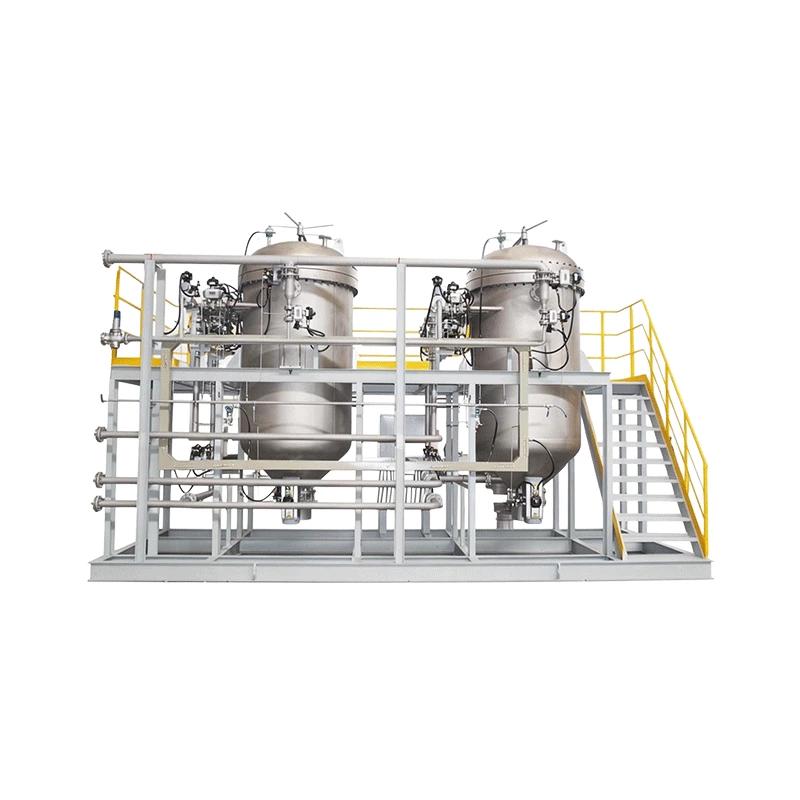
A candle filter uses multiple tubular filter elements within a pressure vessel. It is commonly evaluated for fine solid-liquid separation duties where a controlled filtration cycle, contained handling, cake recovery or process integration is important. During filtration, liquid passes through the selected media while solids form a cake on the outside of the elements.
For catalyst recovery, the engineering discussion should focus on whether the catalyst forms a manageable cake, whether the cake can be washed or dewatered as required, how it will be released from the filter elements, and how it will move to the next process step. A suitable system may include defined steps for feed, filtration, displacement or washing, dewatering, cake release and discharge. The exact arrangement depends on the validated process objective.
A candle filter should not be selected simply because the particles are fine. Fine particles can also create challenging resistance, blinding or discharge conditions. The selection needs to consider the full cycle and not only the initial filtrate appearance. For a deeper technical introduction, read how a candle filter works and how to select one.
When to Evaluate a Pressure Leaf Filter
A pressure leaf filter uses multiple filter leaves within a pressure vessel. It can be evaluated for batch solid-liquid separation and clarification duties where a leaf-filter arrangement, precoat approach or process-specific cake-treatment sequence is appropriate.
In a catalyst-recovery context, the relevant questions are similar: How does the cake build on the selected surface? Can the solids be washed, dewatered and released as required? Does the operating sequence align with plant layout, maintenance access and available utilities? The answer depends on the process, not on a generic preference for one equipment name.
An objective comparison should examine both pathways against the same information set. For a side-by-side guide, see the Candle Filter vs Pressure Leaf Filter selection matrix.
Other Process Considerations
Some recovery duties may require a wider review of separation, washing, drying, containment or solids-transfer technology. Do not assume a filter vessel is the full solution when the project also requires pumps, feed conditioning, wash-fluid handling, controls, solids collection, vent treatment or a defined skid boundary. The right system scope should be defined around the process interface and operating responsibilities.
Fine-Solids Filtration: What Determines System Performance?
Fine catalyst solids can make filtration more sensitive to media selection, cake resistance and operating control. As particles accumulate, they create a cake that may improve retention but also restrict liquid flow. The rate at which this happens depends on the particle characteristics, the liquid, the pressure profile and the filtration sequence.
A system that delivers a clear filtrate in a short test may not automatically meet a production target. The project must also confirm throughput, cycle time, acceptable pressure increase, wash performance, dewatering result, cake release, cleaning frequency and behavior under feed variability. These factors should be recorded as design inputs rather than left as assumptions.
| Performance question | Why it should be defined | Example evidence to request or collect |
| Required filtrate quality | Establishes what “successful separation” means | Target residual-solids level, visual requirement, downstream-equipment limit or analytical method |
| Target solids recovery | Determines the value of cake handling and wash steps | Mass balance, recovery target, assay result or re-use requirement |
| Required throughput | Ensures the system supports the production schedule | Batch volume, average/peak flow, operating hours and campaign length |
| Maximum allowable cycle time | Converts filtration behavior into production capacity | Fill, filtration, wash, dewatering, discharge and cleaning time budget |
| Acceptable pressure behavior | Helps set operating limits and identify fouling risk | Normal and maximum differential-pressure range; alarm/trip philosophy |
| Cake discharge requirement | Prevents a technically filtered cake becoming an operational bottleneck | Cake form, moisture target, transfer method, containment and downstream destination |
Cake Washing, Dewatering and Discharge
In many catalyst recovery applications, the retained cake is not merely a waste to remove. It may hold valuable material, residual process liquid or a chemical that must be displaced before transfer. The system design therefore needs to address three related tasks: washing or displacement, dewatering and discharge.
Washing or displacement should be defined around a real objective, such as reducing a residual component, recovering entrained liquid or preparing solids for a subsequent step. Dewatering should be evaluated against the desired cake condition and downstream handling method. Discharge must account for whether the cake is free-flowing, cohesive, wet, hazardous, valuable or prone to exposure during transfer.
It is important not to use general performance claims here. The ability to wash, dewater and release a cake depends on the actual solids, liquid, utilities, filter media, cycle sequence and mechanical design. For an unfamiliar feed, pilot work, sample testing or review of representative operating data can reduce the risk of committing to the wrong discharge arrangement.
Closed Processing, Containment and Materials Compatibility
Catalyst recovery can involve process conditions that require careful attention to containment, vapor handling, corrosion, operator exposure or compatibility with cleaning chemicals. A closed process is not defined solely by a vessel shell. Connections, seals, sampling points, vents, drains, valves, instrumentation, cake discharge and operating procedures all contribute to the overall containment strategy.
The materials review is equally important. The correct wetted materials and seals depend on the complete process chemistry, including normal feed, upset contaminants, wash fluids, cleaning agents and temperature. When the application includes a hazardous-area classification or specific pressure-equipment requirements, provide those standards at the start of the project.
For projects requiring an integrated system boundary, UNITE can evaluate a custom filtration and separation skid that aligns equipment, piping, instruments, controls and documentation around the agreed process scope.
A Practical Catalyst Recovery Filtration Selection Matrix
Use the following matrix during initial project screening. It is designed to identify the questions that must be resolved before final equipment selection.
| Selection area | Key question | What a process team should verify | Possible impact on filter design |
| Solid value | Is the catalyst recovered, reused, regenerated or discarded? | Economic value, quality requirement and downstream routing | Influences cake washing, recovery, containment and discharge scope |
| Particle behavior | Are the solids fine, compressible, abrasive or variable? | Particle-size data, solids load, cake permeability and wear history | Influences media, filtration area, operating pressure and maintenance approach |
| Liquid chemistry | Does the liquid create corrosion, solvent, temperature or cleaning constraints? | Full composition and compatibility assessment | Influences vessel materials, seals, valves and cleaning plan |
| Filtrate requirement | What must the clarified liquid achieve? | Residual-solids target and downstream sensitivity | Influences media, monitoring and filtration endpoint |
| Throughput | What volume or flow must be processed within what time? | Batch schedule, peak flow, availability and campaign duration | Influences filtration area, vessel configuration and automation scope |
| Cake treatment | Is washing, displacement, dewatering or reslurry required? | Wash objective, residual-liquid target, utilities and downstream needs | Influences cycle design and process connections |
| Containment | What level of closed handling is required? | Venting, drainage, solids-transfer route, exposure controls and procedures | Influences full-system layout, not just vessel selection |
| Project execution | What codes, documents and tests apply? | Design code, material traceability, inspections, FAT and documentation | Influences engineering, quality plan and delivery boundary |
Common Mistakes in Catalyst Filtration Projects
The first common mistake is treating the catalyst as a generic solid. Catalyst particles may have very different behavior depending on their size, shape, density, chemistry and prior process history. The second mistake is defining the target only as “clear filtrate.” A project also needs a recovery target, cycle-time requirement and downstream cake-handling plan.
The third mistake is to overlook wash and dewatering requirements until after the filtration vessel is selected. If the retained cake contains valuable product or residual solvent, these steps can be central to the process design. The fourth is considering containment only at the vessel. In practice, the interface points around the vessel often determine whether the system supports the intended handling strategy.
Finally, do not use a single laboratory observation as a full-scale design guarantee. Representative data should be interpreted alongside expected variability, scale-up assumptions, system controls and the complete operating cycle.
What Process Data Should You Send for a Catalyst Recovery Filtration Review?
A well-prepared inquiry helps an engineering team compare options efficiently and identify any information gaps early. The following data set can be submitted with a request for technical review.
| Data category | Minimum information |
| Application objective | Recover, reuse, regenerate, clarify, protect downstream equipment or safely remove solids |
| Liquid phase | Full chemistry, viscosity, density, pH, solvents, contaminants and cleaning fluids |
| Solid phase | Catalyst type or safe description, concentration, particle-size distribution, density, abrasiveness, compressibility and expected variation |
| Operating conditions | Normal/max pressure and temperature, flow rate or batch size, schedule and upset conditions |
| Separation target | Filtrate-quality requirement, solids-recovery objective, analytical method and allowable losses |
| Cake process | Washing, displacement, dewatering, discharge, reslurry, recovery or disposal route |
| Plant interface | Available utilities, space, lifting/access limits, controls, hazardous-area classification and tie-in points |
| Project quality requirements | Codes, materials standards, inspection plan, documents, FAT, certificates and delivery schedule |
Frequently Asked Questions About Catalyst Recovery Filtration
What is catalyst recovery filtration?
Catalyst recovery filtration is the separation of catalyst particles or fines from a liquid process stream so that the clarified liquid, recovered solids or both can be handled according to the process objective. The design depends on the actual catalyst, liquid, filtration target and cake-handling requirements.
What filter is used for catalyst recovery?
The appropriate catalyst recovery filter depends on particle characteristics, liquid chemistry, throughput, filtrate-quality requirement, cake handling and containment needs. Pressure-filtration systems such as candle filters and pressure leaf filters may be evaluated for certain duties, but the final selection should follow a process review and, where needed, representative testing.
Can a candle filter recover fine catalyst solids?
A candle filter can be evaluated for fine-solid recovery applications because it uses multiple filter elements within a closed pressure vessel. Whether it is suitable for a specific catalyst depends on cake formation, media selection, pressure behavior, washing/dewatering needs, cake release and the required downstream handling.
How do you prevent catalyst fines from reaching downstream equipment?
Start by defining the maximum permitted solids level and the failure mode to prevent. Then evaluate the feed variability, particle characteristics, filtration media, operating cycle and monitoring approach. The selected system must be sized for normal operation and credible upset conditions, not only a nominal flow rate.
What information is needed to size a catalyst filtration system?
Provide the liquid composition, catalyst-solids data, solids concentration, flow rate or batch volume, operating pressure and temperature, target filtrate quality, recovery objective, wash/dewatering requirements, discharge plan, automation needs and project standards.
Next Step: Send Catalyst Recovery Process Data for Review
Catalyst recovery filtration works best when the equipment, process sequence and solids-handling route are designed together. If you are evaluating a new project, improving a current separation step or replacing an existing filter, provide the process data outlined above.
Request a technical review from UNITE to discuss an appropriate filtration pathway. You may also review UNITE’s industrial candle filter systems and pressure leaf filter systems before submitting an inquiry.