Cyclonic Filter Separator: Working Principle, Published Parameters, Applications, and Selection Guide
What is a Cyclonic Filter Separator?
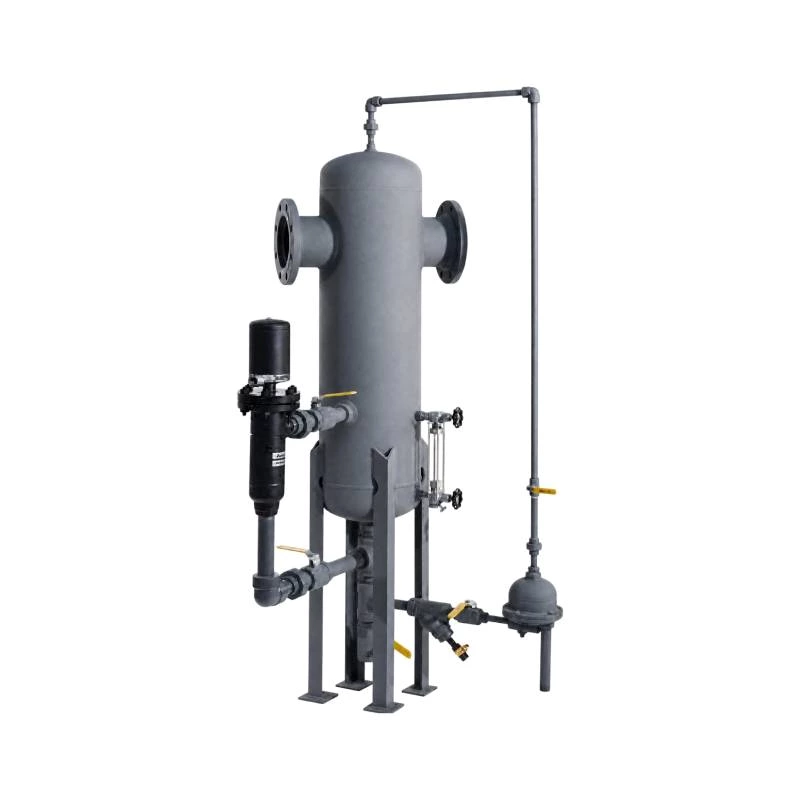
A cyclonic filter separator is used when a gas stream contains a combination of solids, liquid droplets, condensate, or other entrained contaminants. Instead of relying only on filter media, the equipment creates a controlled vortex. The resulting centrifugal force moves heavier particles and droplets toward the cyclone wall, where they lose momentum and collect for discharge. The cleaned gas then exits through the central outlet.
For industrial buyers, the main value is not simply “filtration.” It is the opportunity to remove a substantial contaminant load at the front of a gas-treatment train. This can reduce the burden on finer downstream filters, coalescers, compressors, instruments, and other process equipment. The actual result depends on the gas composition, contaminant size distribution, operating envelope, and final system configuration.
How does the separation process work?
1. Tangential gas entry
According to UNITE’s product description, dirty gas enters the cyclone tube tangentially at two points. The inlet arrangement initiates a high-speed swirling flow inside the tube.
2. Centrifugal separation
The casing and internal flow path force the gas to rotate. Because liquid droplets and solid particles have greater inertia than the gas, the centrifugal field drives them toward the inner wall of the cyclone tube. Larger or denser contaminants are generally easier to separate than fine aerosols, although performance must be confirmed for the actual process conditions.
3. Collection and discharge
Separated particles and liquid move down the wall and collect at the lower section. The equipment must therefore be connected to a suitable liquid-drainage and solids-handling arrangement. Drainage design, level control, isolation, and maintenance access should be considered during procurement rather than treated as secondary details.
4. Clean-gas outlet
The gas reverses direction through the central annulus and exits from the top outlet. In a multi-stage gas-treatment system, the outlet may lead to a coalescer, dry-gas filter, compressor, dehydration package, or another process unit.
Key components and configuration options
UNITE describes several configuration choices that may affect installation and maintenance:
•Multi-tube or vortex-tube separators: The product page describes multi-tube separators for gas-flow applications and vortex-tube separators for condensate and liquid-contaminant removal.
•Fixed or removable cyclones: Fixed elements can be selected where stable installation is the priority; removable elements may support access and cleaning requirements.
•2-inch or 4-inch cyclone diameters: UNITE presents these as available options for different flow and separation requirements. The correct choice requires process-data review.
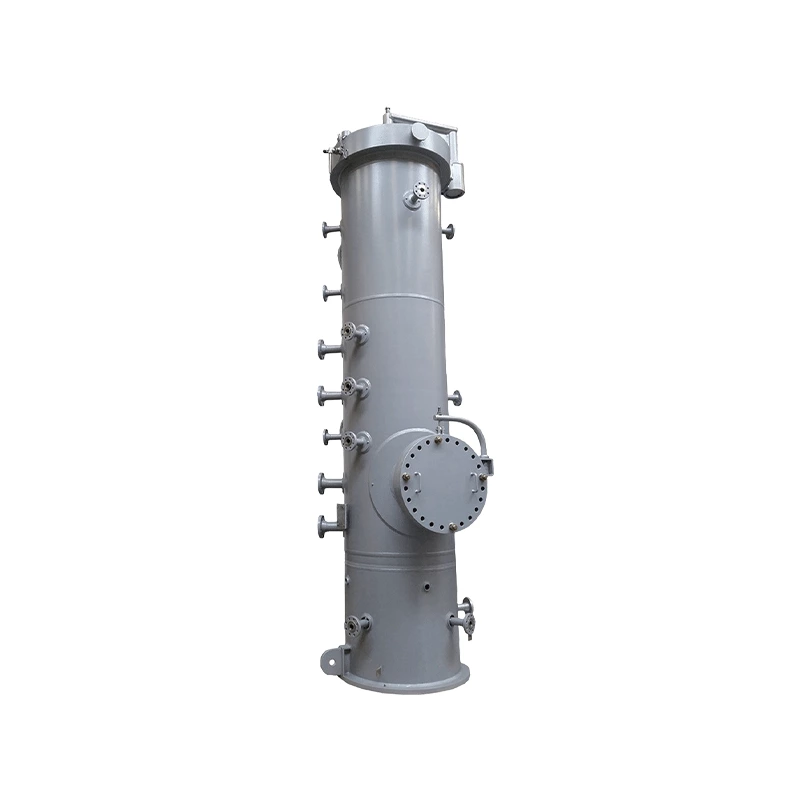
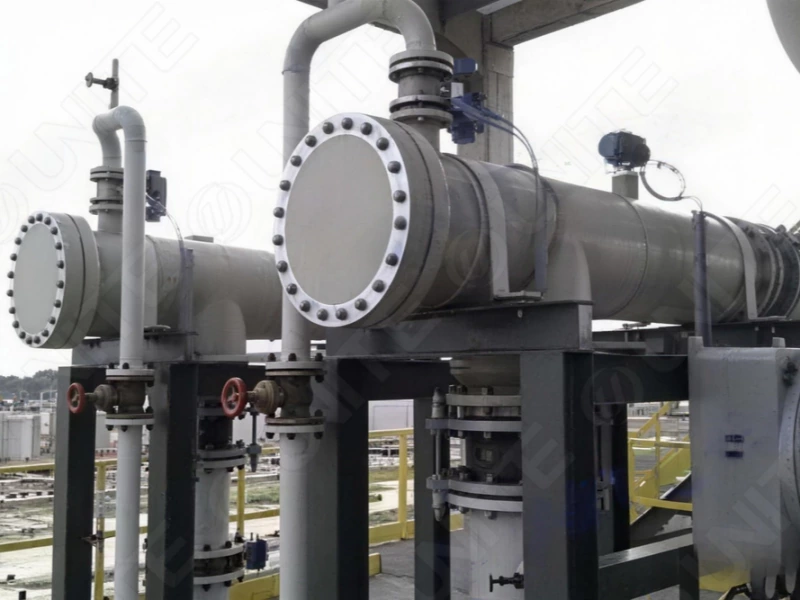
•Vertical or horizontal arrangement: The product page states that both configurations are available for different installation and process requirements.
•Materials for corrosive service: UNITE states that critical components can be manufactured from corrosion-resistant alloys for corrosive gas environments. The selected alloy, corrosion allowance, lining, and inspection requirements should be confirmed against the process medium.
Published reference parameters
The following values are published on UNITE’s gas filtration and separation series page. They should be treated as reference ranges for the product series, not as a performance guarantee for every unit, gas composition, or operating condition.
| Parameter | UNITE-published reference information | Procurement note |
| Separation / filtration accuracy | 5–10 μm for liquid/solid contaminants | Confirm whether the stated value applies to the required contaminant type, test method, and operating point. |
| Temperature range | -40°C to 400°C | Confirm design temperature, start-up/shutdown conditions, seals, insulation, and heat tracing where applicable. |
| Flow rate | 1,000–500,000 Nm³/h | Confirm normal, minimum, maximum, turndown, and intermittent peak flow. |
| Operating pressure | 0.1–25.0 MPa | Confirm design pressure, relief scenario, pressure drop, vessel code, and piping class. |
| Cyclone options | Fixed or removable; 2-inch or 4-inch cyclones | Select based on flow distribution, separation target, access, and maintenance philosophy. |
| Installation | Vertical or horizontal configurations stated as available | Check footprint, nozzle orientation, drainage, lifting, access, and skid layout. |
A quotation should also identify the expected pressure drop, allowable liquid carryover, solids loading, vessel and internal materials, drain arrangement, instrumentation, inspection scope, and any downstream filtration stage. These items are not interchangeable across projects.
Main advantages and limitations
Advantages
UNITE identifies the following product and series-level advantages: liquid and solid removal, intermittent-flow peak capacity, fixed or removable cyclone separators, compact design, high dirt-holding capacity, and stable operation. The product FAQ also describes no moving parts, low maintenance, high dust-load capability, low pressure drop, and continuous operation as key advantages.
The equipment can be particularly attractive for buyers who need a robust first separation stage in a gas-processing train. Centrifugal separation does not depend on replacing filter media for the initial bulk-removal step. This may simplify maintenance, but the complete system still needs inspection and cleaning arrangements for collected solids, liquid drains, valves, instruments, and any downstream filter elements.
Limitations and engineering cautions
A cyclone is not automatically the right answer for every contaminant. Very fine liquid mist or submicron aerosols may require a coalescer or another high-efficiency filtration stage. UNITE’s process-gas guidance distinguishes larger droplets, which may suit gas-liquid separators, from fine mist, which may require coalescing equipment.
Separation performance also depends on inlet pressure, flow velocity, particle and droplet size, density difference, viscosity, gas composition, solids concentration, temperature, and cyclone geometry. A published range should therefore not be read as a guaranteed removal efficiency at all conditions.
Finally, high solids loading, abrasive particles, corrosive gas, low-temperature operation, and hazardous-area requirements can materially change the required materials, wall thickness, internal protection, instrumentation, and certification package.
Where are Cyclonic Filter Separators used?
UNITE lists applications across natural gas processing, oil and gas, petrochemical, chemical, industrial gas, power, cement, metallurgy, mining, and compressed-air systems. The selection logic is similar across these sectors: remove bulk liquid and solid contamination before it can damage or overload downstream equipment.
Typical procurement scenarios include:
•Natural gas and process gas: Removal of sand, pipe scale, moisture, and hydrocarbon carryover before compression, dehydration, pipeline transmission, or LNG-related treatment.
•Oil and gas and petrochemical plants: Protection of compressors, valves, instruments, catalyst or treatment units, and downstream coalescing filters.
•Compressed air: Condensate and liquid-contaminant removal, subject to the required air quality and downstream treatment specification.
•Chemical gas systems: Separation where corrosive media or special materials must be considered.
•Power, mining, cement, and metallurgy: Gas or air streams carrying dust, liquid droplets, or abrasive solids.
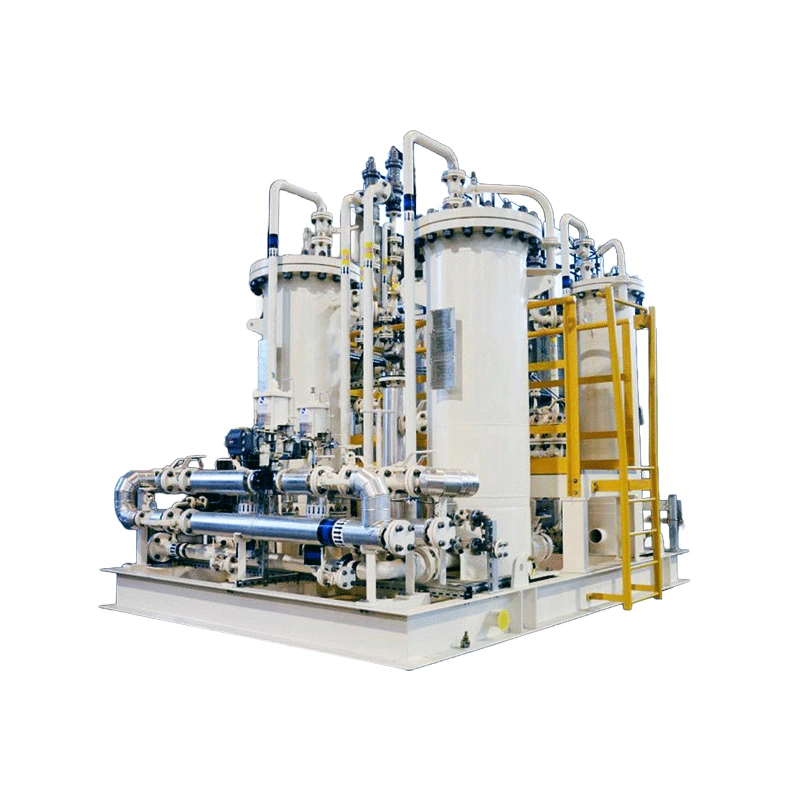
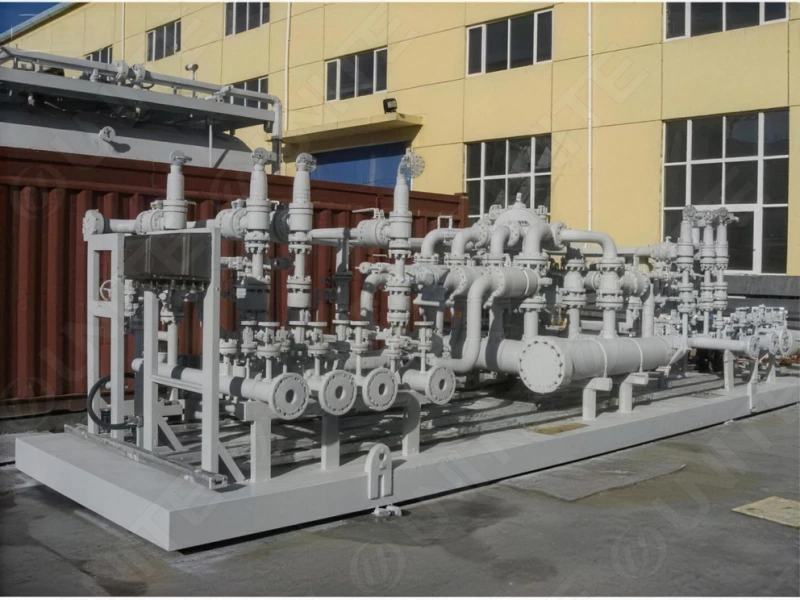
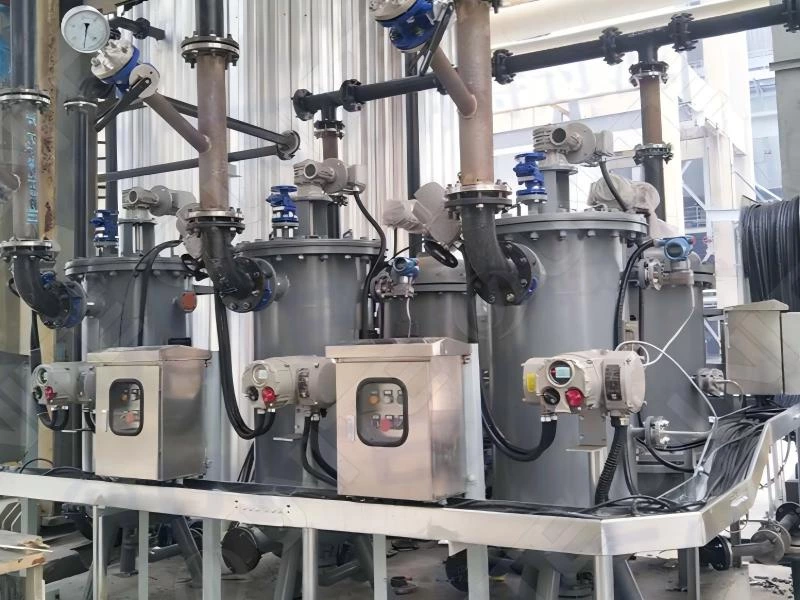
•Packaged process systems: Integration into a skid with piping, valves, instrumentation, controls, and other filtration stages.
What does a gas-treatment train look like?
A cyclone is often most useful as part of a staged system rather than as an isolated piece of equipment. UNITE’s Gazprom case study describes a first stage using cyclonic or vane separation for bulk solids and droplets, followed by high-precision coalescing elements for microscopic aerosols.
This arrangement reflects a common engineering principle: use centrifugal separation for the heavier load, then use finer filtration or coalescence for the residual contamination. The final sequence should be selected from process data, including contaminant size distribution and the protection requirements of the next item of equipment.
For projects requiring a packaged solution, UNITE states that its skid-mounted systems can combine filtration, gas-liquid separation, piping, valves, instrumentation, and control systems. The company also describes process-data review, material and automation selection, factory testing, and commissioning support as part of its engineering approach.
Cyclonic Filter Separator selection checklist for buyers
Before requesting a quotation, prepare the following information:
1.Gas composition: Include corrosive components, condensable hydrocarbons, water content, and any hazardous constituents.
2.Operating envelope: Provide normal, minimum, maximum, start-up, shutdown, and intermittent peak flow; pressure; temperature; and allowable pressure drop.
3.Contaminant profile: State solid type, particle-size distribution, concentration, liquid type, droplet-size distribution, and expected loading changes.
4.Required outlet quality: Define the downstream equipment’s allowable solids and liquid carryover, rather than specifying only a generic “high efficiency.”
5.Materials and mechanical design: Confirm vessel material, cyclone/internal material, corrosion allowance, wear protection, design code, inspection, and coating requirements.
6.Configuration: Review vertical versus horizontal installation, cyclone diameter, fixed versus removable elements, nozzle orientation, drainage, access, and lifting.
7.Automation and safety: Specify level or differential-pressure monitoring, automatic drain or blowdown logic, alarms, hazardous-area requirements, heat tracing, and control-system interfaces.
8.Maintenance philosophy: Clarify whether the plant expects online operation, manual cleaning, spare internals, element access, and planned shutdown intervals.
9.Integration scope: Decide whether the purchase is for a vessel only, a separator package, or a complete skid with piping, valves, instruments, and controls.
Case-study perspective: natural gas filtration and separation
UNITE’s Gazprom case study describes a large-scale natural gas application involving high pressure, large flow, extreme cold, and high-precision separation requirements. The reported system used a first-stage cyclone or vane separator followed by coalescing filtration, together with automated level and differential-pressure control.
The case study reports that the system operated through severe winters and that downstream compressor failure rates were reduced by more than 30%. This is a project-specific reported result, not a universal performance promise. The outcome depends on the final configuration, gas quality, operating conditions, maintenance practices, and the downstream equipment protected.
Frequently Asked Questions
What is the difference between a cyclone separator and a filter separator?
A cyclone separator primarily uses centrifugal force generated by swirling flow. A filter separator may combine this pre-separation effect with filter elements or another fine-removal stage. UNITE positions the Cyclonic Filter Separator as a multi-stage gas-purification product and explains that cyclonic separation can remove larger particles and droplets before further filtration.
Can a Cyclonic Filter Separator remove fine liquid mist?
It can remove liquid droplets within the applicable design range, but fine aerosols may require a coalescer or another polishing stage. UNITE’s process-gas guidance recommends considering droplet size, pressure, flow rate, and gas composition when selecting between separators and coalescers.
What flow rate and pressure can it handle?
UNITE publishes a series-level reference flow range of 1,000–500,000 Nm³/h and an operating-pressure range of 0.1–25.0 MPa, with a stated temperature range of -40°C to 400°C and 5–10 μm liquid/solid reference accuracy. The applicable design point must be confirmed for the selected model and process.
Does it have moving parts?
UNITE’s multi-cyclone scrubber description states that separation is achieved without moving components. The complete package may still include valves, drains, transmitters, control hardware, or other actuated devices, depending on the project scope.
Is it suitable for corrosive gas?
UNITE states that critical components can be manufactured from corrosion-resistant alloy materials for corrosive gas environments. Buyers should provide the full gas composition, water content, temperature, pressure, corrosion mechanism, and required service life so the material selection can be engineered and documented.
What information should be submitted for a quotation?
At minimum, provide gas composition, normal and maximum flow, pressure and temperature, particle and droplet data, allowable pressure drop, required outlet quality, materials, installation orientation, drainage requirements, automation interface, and applicable inspection or certification requirements. UNITE provides customized filtration and separation solutions and invites buyers to submit process requirements for engineering review.
Conclusion
A Cyclonic Filter Separator is a practical front-end separation option for gas streams carrying liquid droplets and solid particles. Its swirling-flow design uses centrifugal force to remove bulk contamination before further filtration, helping protect downstream equipment and support reliable process-gas operation.
The most important purchasing decision is not the nominal size alone. It is the match between the separator and the actual gas composition, contaminant profile, pressure, temperature, flow range, allowable pressure drop, materials, drainage system, automation, and downstream protection requirements. For complex projects, a staged or skid-mounted system may be more appropriate than a standalone vessel.
To request a project-specific review, contact UNITE’s engineering team with your process data and installation requirements.
References
[1] UNITE Cyclonic Filter Separator
[2] UNITE Coalescence-Separation Series
[3] UNITE Gas-Liquid Separation for Process Gas
[4] UNITE Gazprom Natural Gas Processing Filtration and Separation System