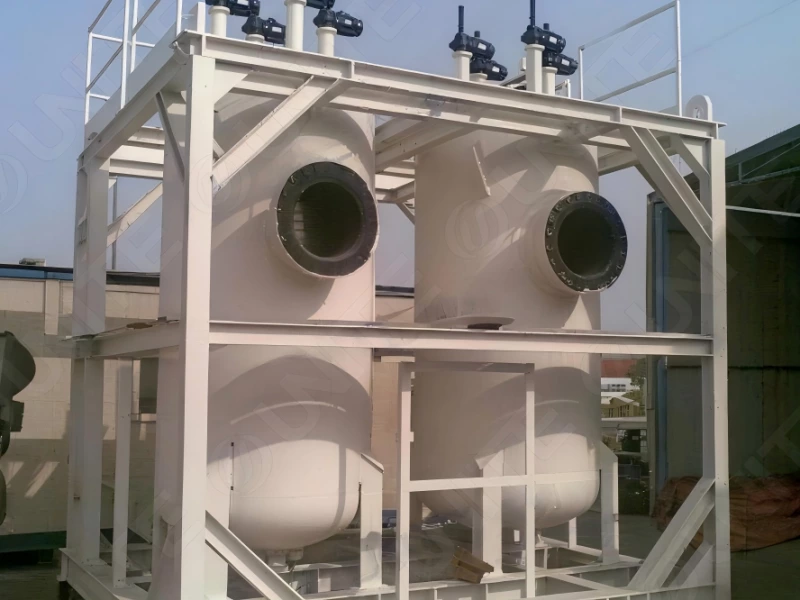
Self-Cleaning Filter vs Strainer: Key Differences & When to Use Each
TL;DR: A strainer is a simple, passive inline device that captures particles in a fixed screen and requires manual cleaning when loaded. A self-cleaning filter is an automated system that continuously cleans its filter screen without process interruption. Choose a strainer for low-contamination, equipment-protection applications. Choose a self-cleaning filter for continuous, high-contamination, or unattended operations.
Defining the Two Technologies
What Is a Strainer?
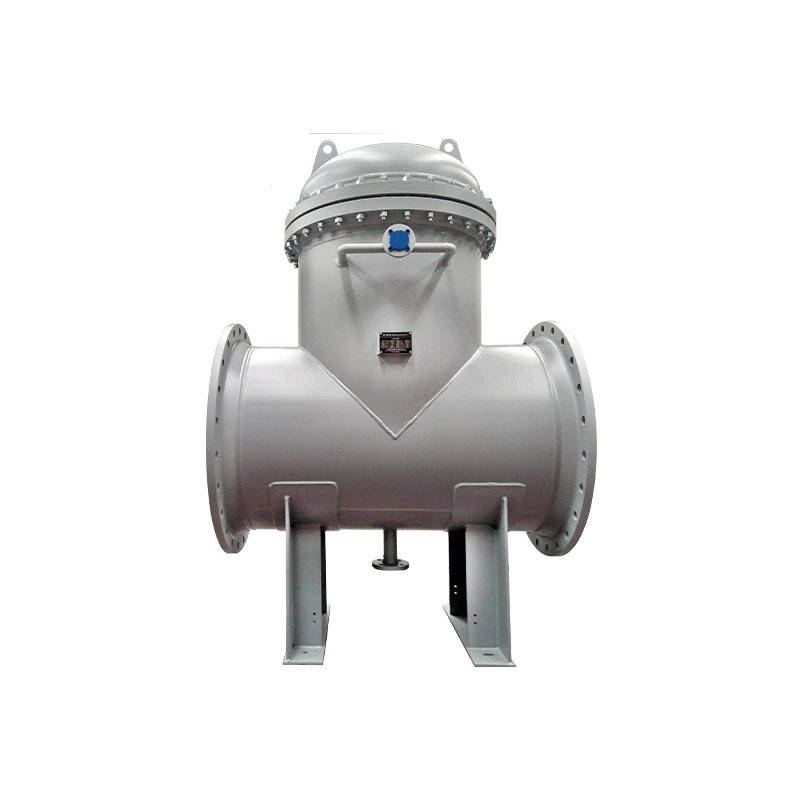
An industrial strainer is a passive inline filtration device consisting of a mesh or perforated screen inside a compact housing (Y-body, T-body, or basket housing). The screen captures particles as fluid flows through it. When the screen is loaded, an operator must isolate the strainer, remove the screen basket, clean it manually, and return it to service.
Strainers have no moving parts, require no power supply, and perform one simple function: hold a screen in the flow path and accumulate solids until cleaned.
Defining characteristics:
•No automatic cleaning mechanism
•Manual cleaning or element replacement required
•Simple construction; very low cost
•No power requirement
•Process must be isolated (or diverted to bypass) for cleaning
What Is a Self-Cleaning Filter?
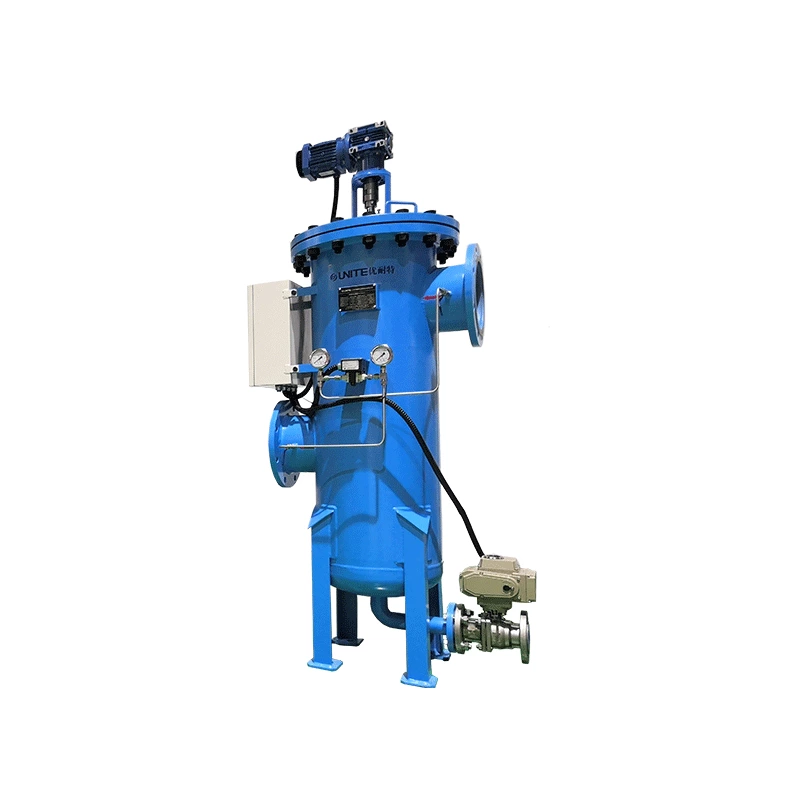
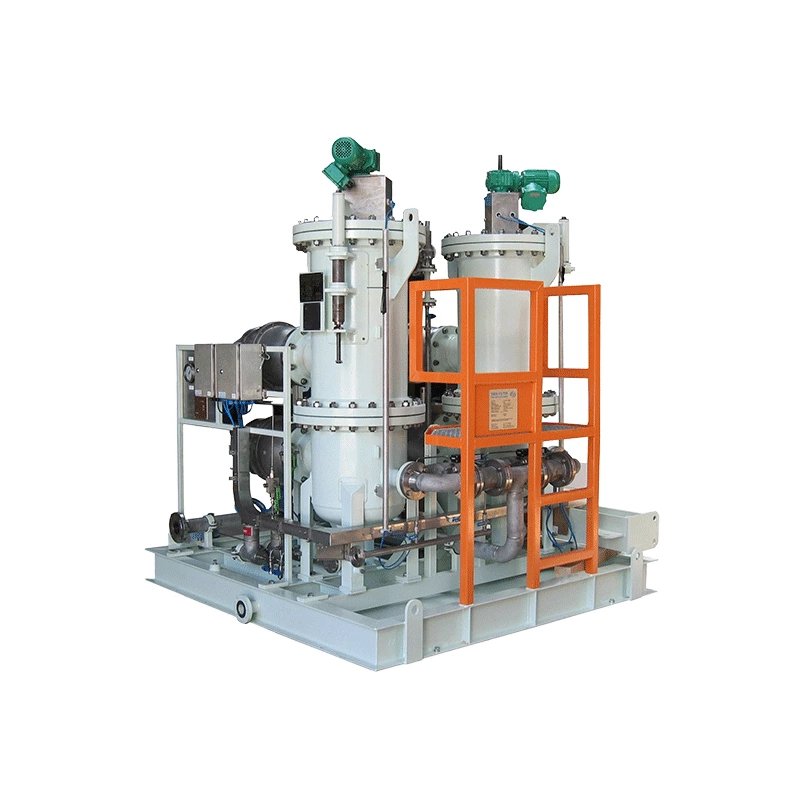
A self-cleaning filter is an automated filtration system that uses a motorized cleaning mechanism — brush, scraper, or suction scanner — to continuously remove accumulated solids from the filter screen without stopping the process. A differential pressure controller monitors screen loading and triggers cleaning cycles automatically.
Defining characteristics:
•Automatic cleaning mechanism (motor-driven)
•Process flow continues uninterrupted during cleaning
•Requires electrical power for motor and controller
•Higher capital cost than strainers
•Designed for continuous, unmanned operation
The Fundamental Difference: Manual vs. Automatic Cleaning
Everything else flows from this single distinction. A strainer requires you to come to it; a self-cleaning filter manages itself.
This sounds simple, but the operational implications are significant:
For a strainer, the cleaning frequency defines the maintenance burden. In a low-contamination system where the strainer fills once a month, this is entirely acceptable. In a high-contamination system where the strainer fills daily, you have created a demanding maintenance routine, risk process interruptions, and potentially cannot maintain continuous operation.
For a self-cleaning filter, cleaning frequency is irrelevant from an operational standpoint. Whether it cleans once per hour or once per day, the process never stops and no operator is needed. The filter tracks its own cleaning history — unusually high cleaning frequency signals an upstream process change worth investigating.
Detailed Comparison
| Parameter | Strainer | Self-Cleaning Filter |
| Cleaning Method | Manual (operator removes and cleans basket) | Automatic (motor + controller) |
| Process Continuity | Interrupted for cleaning (or bypass required) | ✅ Never interrupted |
| Cleaning Frequency Impact | High burden if frequent cleaning needed | Irrelevant operationally |
| Operator Requirement | Present for each cleaning | Monitoring only |
| Power Requirement | None | Electric (0.1–0.75 kW typical) |
| Moving Parts | None | Motor, drive shaft, cleaning mechanism |
| Filtration Accuracy Range | 75 microns – 5 mm (typically) | 25 – 3,000 microns |
| Solids Loading Tolerance | Low (frequent cleaning if high) | High (continuous cleaning) |
| Capital Cost | Very Low ($100–$2,000) | Medium-High ($2,000–$50,000+) |
| Operating Cost | Labor for cleaning; minimal otherwise | Electricity; occasional maintenance |
| Remote / Unmanned Sites | ❌ Not suitable | ✅ Ideal |
| Maintenance Complexity | Very Low | Moderate (mechanical components) |
| Footprint | Minimal (inline) | Larger (housing + controller) |
Filtration Accuracy: Closer Than You Think
Both strainers and self-cleaning filters operate in a broadly overlapping accuracy range — both are effective from approximately 75 microns to 3,000 microns. This means accuracy alone rarely determines the choice between them.
Where strainers have a slight edge: Very coarse protection (>1,000 microns) where a simple perforated plate is adequate and a self-cleaning mechanism adds unnecessary complexity.
Where self-cleaning filters have a slight edge: Finer end of the shared range (75–200 microns), where self-cleaning mechanisms maintain consistent filtration more reliably than a heavily-loaded strainer screen.
When to Use a Strainer
Low Contamination, Equipment Protection
The classic strainer application: protecting a pump, control valve, or meter from the occasional piece of pipe scale, welding debris, or assembly hardware left in the pipeline during construction or maintenance. In clean service, the strainer may never need cleaning between scheduled maintenance shutdowns.
Examples:
•Pump suction strainers in clean water or cooling water systems
•Control valve body strainers in instrument air and clean process lines
•Flow meter inlet strainers in utility systems
Infrequent Cleaning is Acceptable
Any application where operational analysis shows cleaning will be needed only monthly, quarterly, or less — and where a brief isolation for cleaning causes no meaningful operational problem. At this frequency, the capital and complexity of a self-cleaning filter cannot be economically justified.
Very Low Flow or Small Pipe Sizes
For pipe sizes below DN50 (2-inch), self-cleaning filters are rarely available or practical. Small-bore Y-strainers are the standard solution for instrument protection, sampling lines, and small utility services.
Budget-Constrained Projects
When capital cost minimization is the governing constraint and an operator is readily available for maintenance, strainers offer the lowest possible investment. A $200 Y-strainer vs. a $5,000 self-cleaning filter is a justified choice when cleaning frequency is once per month.
When to Use a Self-Cleaning Filter
High Contamination Loads
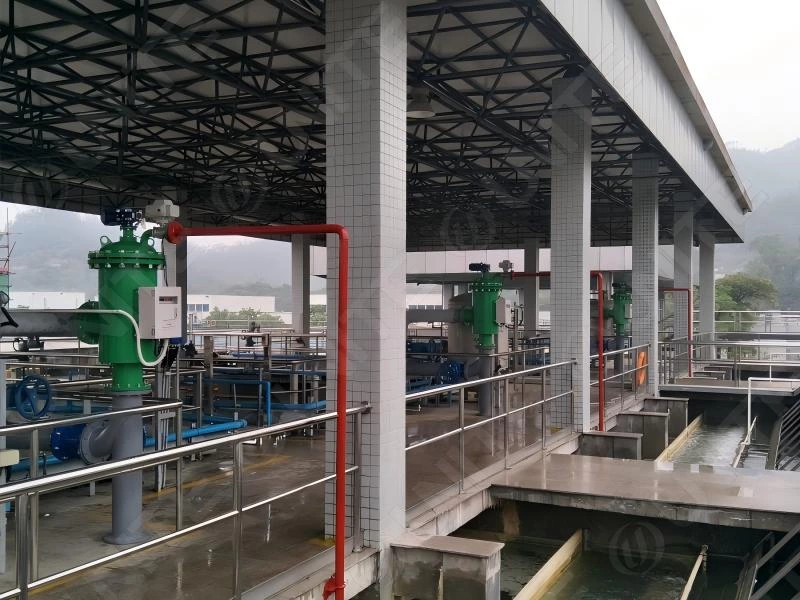
When the process fluid carries sustained particulate contamination — river water intake, cooling tower water, industrial wastewater recycle, irrigation systems, seawater — a strainer would require cleaning so frequently as to be impractical. A self-cleaning filter handles this effortlessly, cleaning multiple times per hour if necessary without any operational impact.
Continuous Production Processes
In processes where any interruption to flow is unacceptable — or where the cost of a brief bypass and strainer cleaning significantly exceeds the cost premium of a self-cleaning filter — automation is the right investment.
Examples: Continuous chemical reactors, power plant cooling systems, 24/7 process water systems, water injection systems in oil production
Remote and Unmanned Installations
Offshore platforms, pipeline compressor stations, remote pumping stations, and irrigation system control points all share a common constraint: operator attendance is limited or expensive. A self-cleaning filter with remote monitoring (4–20mA differential pressure signal, alarm output to SCADA) can operate for months without a service visit.
High-Value Process Streams
When the cost of an unplanned production stop — due to a clogged strainer causing pump damage or process upset — greatly exceeds the cost of the self-cleaning filter, automation is economically obvious. In refinery and petrochemical service, a single unplanned shutdown event can cost more than the filter itself.
Variable or Unpredictable Contamination
In processes where contamination levels fluctuate unpredictably — seasonal changes in water quality, episodic contamination from upstream upsets — a self-cleaning filter adapts automatically by cleaning more or less frequently. A strainer operator must somehow anticipate these changes or react to them with emergency maintenance.
Total Cost of Ownership: A Practical Comparison
For a 200 m³/h cooling water filtration application at 200-micron accuracy, moderate contamination (strainer cleaning needed twice weekly):
Duplex Basket Strainer (manual, no process interruption)
| Cost Item | Annual Cost |
| Equipment (amortized 15 years) | $800 |
| Labor: 104 cleanings × 20 min × $50/hr | $1,730 |
| Miscellaneous (consumables, seals) | $200 |
| Annual Total | ~$2,730 |
Automatic Self-Cleaning Filter
| Cost Item | Annual Cost |
| Equipment (amortized 15 years) | $2,500 |
| Electricity (0.37 kW) | $320 |
| Annual service (1 inspection) | $500 |
| Annual Total | ~$3,320 |
At twice-weekly cleaning: strainer is marginally cheaper. But as contamination increases to daily or multiple-daily cleaning cycles, the labor cost of the strainer escalates rapidly and the self-cleaning filter becomes substantially more economical.
The crossover point: For most applications, the self-cleaning filter becomes the economically superior choice when cleaning is needed more than once per week.
A Common Mistake: Upgrading Too Late
A typical scenario: a plant installs basket strainers on a process water system. Initially, cleaning is needed weekly — manageable. Over time, the water source quality deteriorates, the system ages, and cleaning is needed 3–4 times per week. Operators begin to resent the maintenance burden; occasionally the strainer is left in service past its optimal cleaning point, causing pump wear. Eventually, an unplanned pump failure forces an emergency shutdown that costs far more than a self-cleaning filter upgrade would have.
The lesson: evaluate contamination trends during design, not just initial conditions. If there is any reasonable expectation that cleaning frequency will increase over the equipment life, installing a self-cleaning filter from the start is almost always the correct economic decision.
Frequently Asked Questions
Q: Can a self-cleaning filter completely replace all strainers in a plant?For most continuous process applications with meaningful solids loading, yes. However, small-bore pipeline strainers (DN50 and below) protecting individual instruments, analyzers, and control valves typically remain as the most practical local protection — even in plants that use self-cleaning filters on main process lines.
Q: Do self-cleaning filters have a minimum flow requirement?Yes. Most self-cleaning filters require a minimum process flow to function effectively — typically 20–30% of rated flow. Below this, the hydraulic conditions inside the filter may not support effective cleaning. Consult the manufacturer for minimum flow specifications when sizing for variable-flow applications.
Q: If I install a self-cleaning filter, do I still need strainers on pump suctions?Typically yes. A strainer on pump suction provides last-line protection for the pump impeller from large debris (pipe end caps, assembly materials). Even with a self-cleaning filter upstream, a coarse strainer (>1,000 micron) on each pump suction is considered good engineering practice.
Q: What maintenance does a self-cleaning filter require?Annual inspection of the cleaning mechanism (brush, scraper, or suction scanner); verification of differential pressure sensor calibration; drain valve function test; check of motor and gearbox lubrication. Total annual maintenance time: typically 2–4 hours. Some manufacturers offer 3-year service intervals for light-duty applications.
Related Articles
•What Is a Self-Cleaning Filter? Working Principle, Types & Applications
•Self-Cleaning Filter vs Backwash Filter: Key Differences & Selection Guide
•Automatic Filter vs Manual Filter: Cost, Efficiency & Maintenance Comparison
•What Is a Pipeline Filter? Working Principle, Types & Applications